Saturday, 3 October 2009

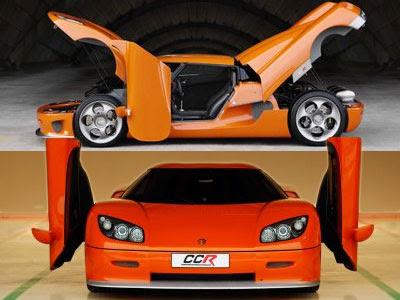
Koenigsegg CCR Design Sport Car Concept

Koenigsegg CCR Design Sport Car Concept

Koenigsegg's design seeks to give an interpretation of strength and flowing motion. The body of a Koenigsegg is formed for one ultimate purpose; speed. Its beauty is the beauty of speed itself. The surfaces are shaped to perfectly aerodynamic, an appearance that does not deceive. All aspects of this machine serve its one fundamental objective. Both the body and chassis of a Koenigsegg are made of extremely lightweight carbon fibre composite, reinforced with Kevlar and aluminium honeycomb. Its race-bred suspension system brings the driver in control of all movement, even under the toughest racing conditions.
The car was styled by Christian von Koenigsegg himself but its shape is largely dictated by aerodynamics. It is not as striking as Pagani or Enzo. At some angles it even looks bulky, like a big whale. But the whale delivers a sense of power that you can't find in its rivals either. Because of the targeted top speed, the body is designed to be so smooth that it has a very low drag coefficient of 0.30. This is much lower than Enzo (0.36), SLR (0.37) and Carrera GT (0.39). Unsurprisingly, the downside is a rather low downforce, just 50kg at the front and 70kg at the back. For comparison, an Enzo generates 775kg while Pagani achieves 500kg.
The chassis is constructed like other supercars. Central to it is a carbon-fiber tub (Koenigsegg called it "semi-monocoque") attached with steel subframe up front and aluminum subframe at the rear for mounting engine, gearbox and suspensions. Chassis rigidity is 28,100Nm per degree despite of the targa roof. The whole bodyshell is also carbon-fiber. Koenigsegg claims a dry weight of 1175kg, which translates to 1275kg when fluid and fuel are loaded, i.e., what we usually refer to "kerb weight". In other words, CC8S is about as light as Pagani and Saleen S7, while being around 100 kilograms lighter than Enzo and Carrera GT.

2010 Hyundai Sonata i40 Electric Hybrid Concept Car

2010 Hyundai Sonata i40 Electric Hybrid Concept Car

Hyundai
presented the next generation Sonata sedan, which is on the European market would be called i40.
2010 Hyundai Sonata gets a new platform and a different range of engines, which will include a series of turbo diesel “R” and the four-and six-cylinder petrol engines. It is also expected to modify the appearance of 228-strong hybrid that combines 2.0-liter turbo-charged (according to other sources - 2.4-liter) capacity of 30 kilowatt electric motor, lithium-ion batteries, and six-speed automatic transmission.
In the sale of novelty will appear early next year. According to some foreign publications in Europe, first to the market can go touring Hyundai i40, then hatchback, sedan and the hybrid version.

2010 Hyundai Sonata i40 Electric Hybrid Concept Car

2010 Hyundai Sonata i40 Electric Hybrid Concept Car

Hyundai
presented the next generation Sonata sedan, which is on the European market would be called i40.
2010 Hyundai Sonata gets a new platform and a different range of engines, which will include a series of turbo diesel “R” and the four-and six-cylinder petrol engines. It is also expected to modify the appearance of 228-strong hybrid that combines 2.0-liter turbo-charged (according to other sources - 2.4-liter) capacity of 30 kilowatt electric motor, lithium-ion batteries, and six-speed automatic transmission.
In the sale of novelty will appear early next year. According to some foreign publications in Europe, first to the market can go touring Hyundai i40, then hatchback, sedan and the hybrid version.

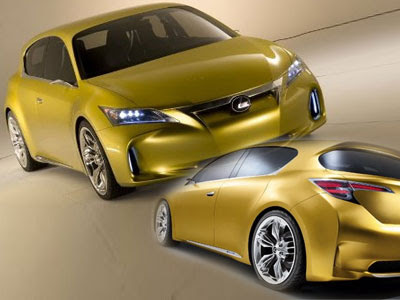
Lexus LF-Ch Hybrid Sport Concept Car

Lexus LF-Ch Hybrid Sport Concept Car

The Lexus LF-Ch Concept Car will be known as the commodity car, which will take the belt in the autumn of next year, is not yet known. World premiere of Lexus LF-Ch will be held at the international Motor Show in Frankfurt.
Lexus hatchback concept hybrid will get a power plant, which will allow the car to move as a pure electric, and with the joint use of conventional gasoline engine and electric motor. The prototype will be equipped with facilities that combines running on the Atkinson cycle four-cylinder 2.4-liter unit, nickel metal hydride batteries, electric motor and CVT. The total capacity of power plant will make 187 horsepower.
According to some reports, the serial-door Lexus will get front-wheel drive (for the moment all models of brand only offered with rear-or all-wheel drive) and will be called the Lexus CT. Note that the Japanese company has already registered the name in the United States CT 200h, CT 300h and CT 400h as trade marks.

Lexus LF-Ch Hybrid Sport Concept Car

Lexus LF-Ch Hybrid Sport Concept Car

The Lexus LF-Ch Concept Car will be known as the commodity car, which will take the belt in the autumn of next year, is not yet known. World premiere of Lexus LF-Ch will be held at the international Motor Show in Frankfurt.
Lexus hatchback concept hybrid will get a power plant, which will allow the car to move as a pure electric, and with the joint use of conventional gasoline engine and electric motor. The prototype will be equipped with facilities that combines running on the Atkinson cycle four-cylinder 2.4-liter unit, nickel metal hydride batteries, electric motor and CVT. The total capacity of power plant will make 187 horsepower.
According to some reports, the serial-door Lexus will get front-wheel drive (for the moment all models of brand only offered with rear-or all-wheel drive) and will be called the Lexus CT. Note that the Japanese company has already registered the name in the United States CT 200h, CT 300h and CT 400h as trade marks.

Pagani Zonda R Clubsport full cell concept sport car

Pagani Zonda R Clubsport full cell concept sport car

The Pagani Zonda R Clubsport - 220 mph (354 km/h) is very unique in its own right but has some tail, tail, signs of other super cars on this page, see if you can spot them. This is a very, very rapidly fast car
The central carbon chassis incorporates a roll cage and a rubber racing fuel cell with 4 fuel pumps and quick refuel filler cap, similar to GT race cars. The wheelbase has been increased by 47 mm (1.9 in) to increase stability. The front and rear subframes are brand-new, built to accommodate new suspension geometry, and produced in Avional. The slick-shod wheels are new forged-magnesium centre-lock models, which in conjunction with on-board pneumatic airjacks (again, like the FXX) allow rapid change of the entire wheel assemblies.
The car senses, displays and logs information about the amount of downforce that is generated at each wheel at all times. It is thought that this system will enable owners to adjust set-up ccording to track conditions and to improve their cornering technique.
Bodywork In addition to the wheelbase increase (47 mm), overall length has increased by 394 mm (15.5 in) and track by 50 mm (2 in). The bodywork and aerodynamics have been altered to offer maximum downforce, featuring a longer front bonnet with flaps, a closed underbody and a new rear overhang with adjustable rear wing and race-derived diffuser. These are intended to translate into increased aerodynamic efficiency and downforce for maximum cornering speed. It is also noted that the car's new rear bodywork is minimal in the extreme, being composed mostly of vent. This is thought to be symptomatic of the need to keep the engine cool enough, even under hard track use. Again, this is similar to the gutted bodywork of the Ferrari Evoluzione.
Engine Output has increased to 750 bhp (559 kW) at 8000 rpm and 523 lb·ft (709 N·m) of torque. A lightweight carbon fibre high performance intake system, racing multiple disc sintered clutch and Formula 1-style exhaust system, hydroformed in Inconel 625 and ceramic coated for optimal heat dissipation, have been added. The engine is combined with a 6-speed transverse-mounted manual sequential synchronized gearb
Interior The car's interior is spartan reflecting the car's racetrack aspirations and intended home, and features bespoke seats, customized to the driver to offer maximum support. As before, the Digitek instrumentation provides essential information and the sophisticated telemetry allows a variety of sensors to monitor numerous aspects of the car.

Pagani Zonda R Clubsport full cell concept sport car

Pagani Zonda R Clubsport full cell concept sport car

The Pagani Zonda R Clubsport - 220 mph (354 km/h) is very unique in its own right but has some tail, tail, signs of other super cars on this page, see if you can spot them. This is a very, very rapidly fast car
The central carbon chassis incorporates a roll cage and a rubber racing fuel cell with 4 fuel pumps and quick refuel filler cap, similar to GT race cars. The wheelbase has been increased by 47 mm (1.9 in) to increase stability. The front and rear subframes are brand-new, built to accommodate new suspension geometry, and produced in Avional. The slick-shod wheels are new forged-magnesium centre-lock models, which in conjunction with on-board pneumatic airjacks (again, like the FXX) allow rapid change of the entire wheel assemblies.
The car senses, displays and logs information about the amount of downforce that is generated at each wheel at all times. It is thought that this system will enable owners to adjust set-up ccording to track conditions and to improve their cornering technique.
Bodywork In addition to the wheelbase increase (47 mm), overall length has increased by 394 mm (15.5 in) and track by 50 mm (2 in). The bodywork and aerodynamics have been altered to offer maximum downforce, featuring a longer front bonnet with flaps, a closed underbody and a new rear overhang with adjustable rear wing and race-derived diffuser. These are intended to translate into increased aerodynamic efficiency and downforce for maximum cornering speed. It is also noted that the car's new rear bodywork is minimal in the extreme, being composed mostly of vent. This is thought to be symptomatic of the need to keep the engine cool enough, even under hard track use. Again, this is similar to the gutted bodywork of the Ferrari Evoluzione.
Engine Output has increased to 750 bhp (559 kW) at 8000 rpm and 523 lb·ft (709 N·m) of torque. A lightweight carbon fibre high performance intake system, racing multiple disc sintered clutch and Formula 1-style exhaust system, hydroformed in Inconel 625 and ceramic coated for optimal heat dissipation, have been added. The engine is combined with a 6-speed transverse-mounted manual sequential synchronized gearb
Interior The car's interior is spartan reflecting the car's racetrack aspirations and intended home, and features bespoke seats, customized to the driver to offer maximum support. As before, the Digitek instrumentation provides essential information and the sophisticated telemetry allows a variety of sensors to monitor numerous aspects of the car.