

Wednesday, 17 February 2010

2011 Third-generation Toyota Sienna Minivan

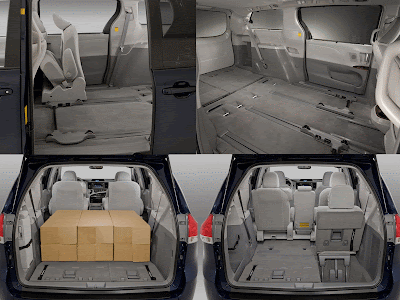
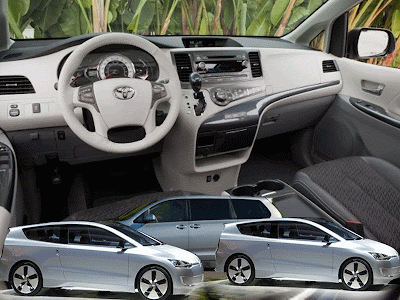
Toyota is the first carmaker in North America to be offering this innovation. The Auto Access Seat has a seat-mounted ingress/egress switch and a wireless remote control that allows for easy and flexible seat operation. The seat is able to rotate 90 degrees and can be lowered to within 19 inches of the ground to further facilitate easier passenger transfers at the exact height required. The Toyota Sienna is well known as a transportation solution for moving people and cargo comfortably and efficiently. The third-generation Toyota Sienna will look and drive more like a sedan, conform to new ideas about personal comfort, easily accommodate cargo, and handle big loads. The Toyota Sienna will come in five conveniently configured grades, all sharing a distinctly new visual direction and features. Toyota unveiled the all-new, third-generation Toyota Sienna minivan at a media conference at the 2009 Los Angeles Auto show.
2011 Third-generation Toyota Sienna Minivan

The 2011 Sienna has been reinvented to handle these needs as it shifts to a more expressive and dynamic vehicle with a stronger profile, high shoulder character and responsive handling. The 2011 Toyota Sienna may be the Japanese automaker's third-generation minivan, but Toyota emphasizes that the new Sienna is becoming more carlike than ever. The Sienna gets smart updates to its drivetrains and to its interior package for 2011-but not to its seating configurations, which still lag the class-leading Dodge Grand Caravan and Nissan Quest in flexibility. The Sienna is offered in a broad model range, and continues to be the only minivan with an all-wheel-drive option.
2011 Third-generation Toyota Sienna Minivan

The third-generation Sienna combines a contemporary style with features not previously seen in a minivan, and a fun-to-drive spirit that will surprise many, along with the flexibility, spaciousness and features that have defined the segment. The Sienna was designed by Toyota's Calty Design Research and developed at Toyota Technical Center in Ann Arbor, Mich., with assembly being accomplished at Toyota Motor Manufacturing, Indiana.
2011 Third-generation Toyota Sienna Minivan

A Toyota first rear-seat Dual View Entertainment Center is another innovative option. The system uses two displays side-by-side to create a seamless 16.4-inch widescreen image from a single source. When two separate entertainment options are called for, the system can split the screen into two individual screens, each with input from separate sources. Used as a single screen, it can be easily seen from the third row, and it can be operated from any seat via remote control. Used as two screens, the system can accommodate the preferences of two separate passengers who might want to play a video game or watch a second DVD simultaneously via auxiliary inputs.
2011 Third-generation Toyota Sienna Minivan

A choice of two responsive DOHC engines will be available: a 3.5-liter V6 or 2.7-liter four-cylinder engine. By adding the alternative of a four-cylinder engine, the 2011 Toyota Sienna is the first minivan in years to stray from the V-6-engine-only formula. Both engines offer the latest in efficient, lightweight technology, including Dual Variable Valve Timing with intelligence (VVT-i), roller rocker arms and an Acoustically Controlled Induction System (ACIS) that changes the length of the air-intake pipe to supply more torque on demand. 
2011 Third-generation Toyota Sienna Minivan

The 3.5-liter V6 makes 266 horsepower at 6,200 rpm, with expected EPA-estimated mileage ratings of 18 mpg city/24 mpg highway (16 mpg city/22 mpg highway on AWD models). It also has a 3,500-pound tow capacity. With 187 horsepower at 5,800 rpm, the 2.7-liter four-cylinder engine produces responsive power that exceeds some competitors V6 performance, while delivering expected EPA-estimated fuel efficiency ratings of 19 mpg city and 26 mpg on the highway. Given its upgraded engineering, every Toyota Sienna will ride well and track cleanly through corners, but none more so than the newest addition to the line: the sporty SE.
2011 Third-generation Toyota Sienna Minivan

The Limited is designed for customers who want all the features with more luxury. The standard equipment list is extensive, including new second-row Lounge Seating and a power 60/40 Split & Stow third-row seat, front and rear parking sonar, dual moonroof, Smart Key, and Safety Connect™. Select options include those available on the XLE plus HID auto high-beam auto-high beam headlamps, rain-sensing wipers, and Pre-Collision System (PCS) with Dynamic Radar Cruise Control.
2011 Third-generation Toyota Sienna Minivan

The Toyota Sienna will come in five grades: Sienna grade, LE, SE, XLE and Limited. All-wheel-drive is available with the V6 on LE, XLE and Limited models. The all-new 2011 Toyota Sienna will begin arriving at Toyota dealerships in February 2010.

2011 Third-generation Toyota Sienna Minivan

Toyota is the first carmaker in North America to be offering this innovation. The Auto Access Seat has a seat-mounted ingress/egress switch and a wireless remote control that allows for easy and flexible seat operation. The seat is able to rotate 90 degrees and can be lowered to within 19 inches of the ground to further facilitate easier passenger transfers at the exact height required. The Toyota Sienna is well known as a transportation solution for moving people and cargo comfortably and efficiently. The third-generation Toyota Sienna will look and drive more like a sedan, conform to new ideas about personal comfort, easily accommodate cargo, and handle big loads. The Toyota Sienna will come in five conveniently configured grades, all sharing a distinctly new visual direction and features. Toyota unveiled the all-new, third-generation Toyota Sienna minivan at a media conference at the 2009 Los Angeles Auto show.
2011 Third-generation Toyota Sienna Minivan

The 2011 Sienna has been reinvented to handle these needs as it shifts to a more expressive and dynamic vehicle with a stronger profile, high shoulder character and responsive handling. The 2011 Toyota Sienna may be the Japanese automaker's third-generation minivan, but Toyota emphasizes that the new Sienna is becoming more carlike than ever. The Sienna gets smart updates to its drivetrains and to its interior package for 2011-but not to its seating configurations, which still lag the class-leading Dodge Grand Caravan and Nissan Quest in flexibility. The Sienna is offered in a broad model range, and continues to be the only minivan with an all-wheel-drive option.
2011 Third-generation Toyota Sienna Minivan

The third-generation Sienna combines a contemporary style with features not previously seen in a minivan, and a fun-to-drive spirit that will surprise many, along with the flexibility, spaciousness and features that have defined the segment. The Sienna was designed by Toyota's Calty Design Research and developed at Toyota Technical Center in Ann Arbor, Mich., with assembly being accomplished at Toyota Motor Manufacturing, Indiana.
2011 Third-generation Toyota Sienna Minivan

A Toyota first rear-seat Dual View Entertainment Center is another innovative option. The system uses two displays side-by-side to create a seamless 16.4-inch widescreen image from a single source. When two separate entertainment options are called for, the system can split the screen into two individual screens, each with input from separate sources. Used as a single screen, it can be easily seen from the third row, and it can be operated from any seat via remote control. Used as two screens, the system can accommodate the preferences of two separate passengers who might want to play a video game or watch a second DVD simultaneously via auxiliary inputs.
2011 Third-generation Toyota Sienna Minivan

A choice of two responsive DOHC engines will be available: a 3.5-liter V6 or 2.7-liter four-cylinder engine. By adding the alternative of a four-cylinder engine, the 2011 Toyota Sienna is the first minivan in years to stray from the V-6-engine-only formula. Both engines offer the latest in efficient, lightweight technology, including Dual Variable Valve Timing with intelligence (VVT-i), roller rocker arms and an Acoustically Controlled Induction System (ACIS) that changes the length of the air-intake pipe to supply more torque on demand. 
2011 Third-generation Toyota Sienna Minivan

The 3.5-liter V6 makes 266 horsepower at 6,200 rpm, with expected EPA-estimated mileage ratings of 18 mpg city/24 mpg highway (16 mpg city/22 mpg highway on AWD models). It also has a 3,500-pound tow capacity. With 187 horsepower at 5,800 rpm, the 2.7-liter four-cylinder engine produces responsive power that exceeds some competitors V6 performance, while delivering expected EPA-estimated fuel efficiency ratings of 19 mpg city and 26 mpg on the highway. Given its upgraded engineering, every Toyota Sienna will ride well and track cleanly through corners, but none more so than the newest addition to the line: the sporty SE.
2011 Third-generation Toyota Sienna Minivan

The Limited is designed for customers who want all the features with more luxury. The standard equipment list is extensive, including new second-row Lounge Seating and a power 60/40 Split & Stow third-row seat, front and rear parking sonar, dual moonroof, Smart Key, and Safety Connect™. Select options include those available on the XLE plus HID auto high-beam auto-high beam headlamps, rain-sensing wipers, and Pre-Collision System (PCS) with Dynamic Radar Cruise Control.
2011 Third-generation Toyota Sienna Minivan

The Toyota Sienna will come in five grades: Sienna grade, LE, SE, XLE and Limited. All-wheel-drive is available with the V6 on LE, XLE and Limited models. The all-new 2011 Toyota Sienna will begin arriving at Toyota dealerships in February 2010.

2010 Ferrari F10 Specifically to compete in the Formula 1 World Championship

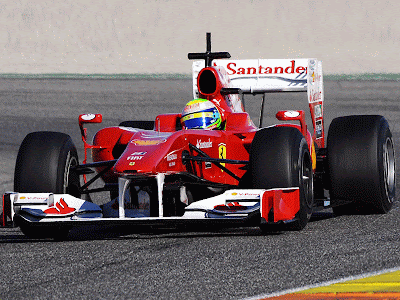
Scuderia Ferrari unveiled today its 2010 challenger, the Ferrari F10. The F10 single-seater was presented with a new livery, with both the front and the rear wing white painted. The F10 is the fifty-sixth single-seater built by Ferrari, specifically to compete in the Formula 1 World Championship. The name of the car renews the tradition of being linked to the year in which it makes its debut in the Championship. The project, which went by the internal code number 661, represents the Scuderia's interpretation of the technical and sporting regulations which apply in 2010. 
2010 Ferrari F10  Formula 1

The rule clarifications issued by the FIA during the course of the previous season as regards to the diffuser have opened up new scenarious for the designers in terms of freeing up this area, thus representing the opportunity to deliver potentially great performance advantages. Compared to the F60, the F10 was obviously conceived with the aim of maximizing the aerodynamic performance of the double diffuser. Therefore the engine mountings to the chassis have been modified in a specific way and also redesigned is the shape of the gearbox casing and the rear suspension layout.
2010 Ferrari F10  Formula 1

It only takes a quick glance to note that the front part of the chassis is considerably higher than on last year's car and that the central upper and lower surfaces are hollowed out, in order to improve airflow. Another major rule change is that race refuelling is banned, which means the fuel cell has to be big enough to allow the car to get to the end of the race, whatever type of circuit. Inevitably, the car is longer to accommodate the new fuel tank and to allow the installation of longer and narrower radiators so that the sidepods have a smaller higher aperture with a more cut-out shape at the bottom. A further tapering as been achieved thanks to a revised and unconventional configuration of the exhausts.
2010 Ferrari F10  Formula 1

The need to start the race with a much heavier car than in the past has required a redesign of the basic characteristics of the braking system, carried out in conjunction with Brembo as well as a new design for the relevant cooling system.
2010 Ferrari F10  Formula 1

Safety levels have been increased thanks to the introduction of new crash tests of the rear bulkhead and the cell with a full load. In light of past incidents and the fact that pit stops will take less time, the wheel nuts have been updated so as to increase security when the car is sent back out on track.
2010 Ferrari F10  Formula 1

Before its track debut, the F10 underwent an intensive dynamic and static bench test program. Significant developments on all areas of the car are built into the program, not just in the run up to the opening round of Bahrain, but throughout the entire year. 
2010 Ferrari F10  Formula 1

As always, much attention has been paid to the performance and optimization of the materials used, at the design stage and through quality control, in an effort to extract the maximum level of performance combined with the highest possible safety levels.

2010 Ferrari F10 Specifically to compete in the Formula 1 World Championship

Scuderia Ferrari unveiled today its 2010 challenger, the Ferrari F10. The F10 single-seater was presented with a new livery, with both the front and the rear wing white painted. The F10 is the fifty-sixth single-seater built by Ferrari, specifically to compete in the Formula 1 World Championship. The name of the car renews the tradition of being linked to the year in which it makes its debut in the Championship. The project, which went by the internal code number 661, represents the Scuderia's interpretation of the technical and sporting regulations which apply in 2010. 
2010 Ferrari F10  Formula 1

The rule clarifications issued by the FIA during the course of the previous season as regards to the diffuser have opened up new scenarious for the designers in terms of freeing up this area, thus representing the opportunity to deliver potentially great performance advantages. Compared to the F60, the F10 was obviously conceived with the aim of maximizing the aerodynamic performance of the double diffuser. Therefore the engine mountings to the chassis have been modified in a specific way and also redesigned is the shape of the gearbox casing and the rear suspension layout.
2010 Ferrari F10  Formula 1

It only takes a quick glance to note that the front part of the chassis is considerably higher than on last year's car and that the central upper and lower surfaces are hollowed out, in order to improve airflow. Another major rule change is that race refuelling is banned, which means the fuel cell has to be big enough to allow the car to get to the end of the race, whatever type of circuit. Inevitably, the car is longer to accommodate the new fuel tank and to allow the installation of longer and narrower radiators so that the sidepods have a smaller higher aperture with a more cut-out shape at the bottom. A further tapering as been achieved thanks to a revised and unconventional configuration of the exhausts.
2010 Ferrari F10  Formula 1

The need to start the race with a much heavier car than in the past has required a redesign of the basic characteristics of the braking system, carried out in conjunction with Brembo as well as a new design for the relevant cooling system.
2010 Ferrari F10  Formula 1

Safety levels have been increased thanks to the introduction of new crash tests of the rear bulkhead and the cell with a full load. In light of past incidents and the fact that pit stops will take less time, the wheel nuts have been updated so as to increase security when the car is sent back out on track.
2010 Ferrari F10  Formula 1

Before its track debut, the F10 underwent an intensive dynamic and static bench test program. Significant developments on all areas of the car are built into the program, not just in the run up to the opening round of Bahrain, but throughout the entire year. 
2010 Ferrari F10  Formula 1

As always, much attention has been paid to the performance and optimization of the materials used, at the design stage and through quality control, in an effort to extract the maximum level of performance combined with the highest possible safety levels.

Tuesday, 16 February 2010

Most Expensive Car Pictures - Aston Martin

Most Expensive Car Pictures - Aston MartinAston Martin One 77 is once from 10 Most Expensive Car in the world with price: U.S. $ 1,500,000
Throne of the most expensive in the world inhabited by the new king with the logo of Aston Martin. Aston Martin will soon be 77 which was officially launched in the near future be sold at a price of U.S. $ 1.5 million dollars (15 billion more) and only produced as many as 77 fruits and forgiveness, has sold-out!
Most Expensive Car Pictures - Aston Martinaston martin picture images
Most Expensive Car Pictures - Aston MartinBerkonfigurasi V12 engine capable of carrying 77 Aston Martin zoomed up speed 97 km / h in 3.5 seconds with a maximum speed limited to 320 km / hour.
With prices like that in place of origin, this car could be worth more than 20 billion if the trafficked here. Kalo here there had been a single message, not dong a test drive ...
Most Expensive Car Pictures - Aston Martinaston martin picture imagesMost Expensive Car Pictures - Aston MartinActually, the record holder of the world's most expensive car this year is the year 1961 Ferrari 250GT is sold at a price of U.S. $ 11 million dollars. But the car is classified as a classic sports car produced a few tens of years ago and has its own history that makes it very expensive.

2011 Honda Odyssey Minivan Concept Debut At The Chicago Auto Show

January 26th, 2010 Honda has confirmed that it will show the next generation of its Odyssey minivan at the Chicago Auto Show on February 2010. Honda today gave us the first look at the next-generation of its award-winning Odyssey minivan with the new Honda Odyssey Concept, which is on display at the 2010 Chicago Auto Show, introduces a sleek and distinctive exterior styling direction for the next generation of the industry's best-selling minivan, set to debut this fall, American Honda Motor Co., Inc..
2011 Honda Odyssey Minivan Concept

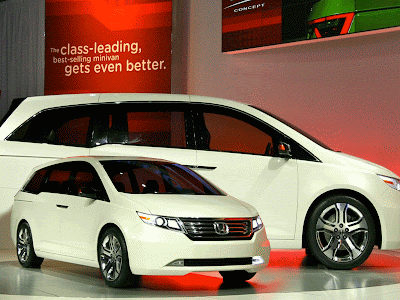
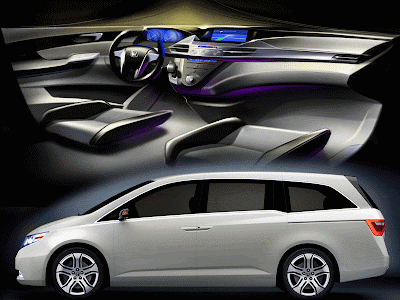
The Odyssey Concept dramatically departs from conventional minivan styling with its low and wide stance, highlighted by a "lightning-bolt" beltline that further distinguishes the vehicle's profile. Compared to the current Odyssey, the Concept's slightly lower roofline (-1.0 inch) and wider stance (+1.4 inch) contribute to a sleeker, stronger and more dynamic presence with improved aerodynamics that help increase fuel economy. Forthcoming improvements to the production Odyssey's interior are designed to further enhance the current model's accommodating space for people and cargo.
2011 Honda Odyssey Minivan Concept

The steeply raked front and rear roof pillars, unique side-glass profile, chamfered roof line, and tapered rear cabin shape combine to create a dynamic and distinctive appearance from any perspective. The lightning-bolt beltline dives toward the rear of the vehicle emphasizing the new Odyssey's sporty appearance while enhancing outward visibility for third-row passengers. Aggressive body-to-wheel proportions reduce the perception of vertical height common to most minivan designs. Fender flares further accent the vehicle's securely planted and stylish persona. The concept vehicle's projector beam headlights, LED taillights and form-fit fog lights further heighten the sophisticated quality of the design.
2011 Honda Odyssey Minivan Concept

Enhanced aerodynamics and advanced powertrain technologies will contribute to the next-generation Odyssey's increased fuel efficiency. The all-new 2011 Odyssey is expected to achieve an EPA-estimated fuel economy rating(1) of 19 city/28 highway miles-per gallon on select models (preliminary estimate determined by Honda).
2011 Honda Odyssey Minivan Concept

Currently in its third generation, the Odyssey's unique array of features, including its superior driving dynamics, 3rd-Row Magic Seat(R) and efficient i-VTEC(TM) V-6 engine with three-mode Variable Cylinder Management(TM) (available) all combine to offer a sophisticated environment with room for up to eight people (seven on Odyssey LX). The Odyssey has been America's best-selling minivan(2) since 2008 and is produced exclusively in Alabama by Honda Manufacturing of Alabama (using domestic and globally sourced parts). Both the concept and production vehicles, along with all development activity for the 2011 Odyssey, are being designed at Honda R&D Americas in Torrance, California, and Raymond, Ohio.
2011 Honda Odyssey Minivan Concept

The Odyssey has won numerous awards and critical acclaim. Recent accolades include the Edmunds.com 2010 "Top Recommended" minivan award, U.S. News and World Report 2010 "Best Minivan for the Money" award, Automotive Lease Guide 2010 "Best Minivan for the Money," the Kelley Blue Book award as one of the ten "Best New Family Vehicles of 2009" and "2009 Best Resale Value Award" in the van category, which recognizes vehicles that are expected to have segment-leading resale value after five years of ownership.
 
2011 Honda Odyssey Minivan Concept

2011 Honda Odyssey Minivan Concept Debut At The Chicago Auto Show

January 26th, 2010 Honda has confirmed that it will show the next generation of its Odyssey minivan at the Chicago Auto Show on February 2010. Honda today gave us the first look at the next-generation of its award-winning Odyssey minivan with the new Honda Odyssey Concept, which is on display at the 2010 Chicago Auto Show, introduces a sleek and distinctive exterior styling direction for the next generation of the industry's best-selling minivan, set to debut this fall, American Honda Motor Co., Inc..
2011 Honda Odyssey Minivan Concept

The Odyssey Concept dramatically departs from conventional minivan styling with its low and wide stance, highlighted by a "lightning-bolt" beltline that further distinguishes the vehicle's profile. Compared to the current Odyssey, the Concept's slightly lower roofline (-1.0 inch) and wider stance (+1.4 inch) contribute to a sleeker, stronger and more dynamic presence with improved aerodynamics that help increase fuel economy. Forthcoming improvements to the production Odyssey's interior are designed to further enhance the current model's accommodating space for people and cargo.
2011 Honda Odyssey Minivan Concept

The steeply raked front and rear roof pillars, unique side-glass profile, chamfered roof line, and tapered rear cabin shape combine to create a dynamic and distinctive appearance from any perspective. The lightning-bolt beltline dives toward the rear of the vehicle emphasizing the new Odyssey's sporty appearance while enhancing outward visibility for third-row passengers. Aggressive body-to-wheel proportions reduce the perception of vertical height common to most minivan designs. Fender flares further accent the vehicle's securely planted and stylish persona. The concept vehicle's projector beam headlights, LED taillights and form-fit fog lights further heighten the sophisticated quality of the design.
2011 Honda Odyssey Minivan Concept

Enhanced aerodynamics and advanced powertrain technologies will contribute to the next-generation Odyssey's increased fuel efficiency. The all-new 2011 Odyssey is expected to achieve an EPA-estimated fuel economy rating(1) of 19 city/28 highway miles-per gallon on select models (preliminary estimate determined by Honda).
2011 Honda Odyssey Minivan Concept

Currently in its third generation, the Odyssey's unique array of features, including its superior driving dynamics, 3rd-Row Magic Seat(R) and efficient i-VTEC(TM) V-6 engine with three-mode Variable Cylinder Management(TM) (available) all combine to offer a sophisticated environment with room for up to eight people (seven on Odyssey LX). The Odyssey has been America's best-selling minivan(2) since 2008 and is produced exclusively in Alabama by Honda Manufacturing of Alabama (using domestic and globally sourced parts). Both the concept and production vehicles, along with all development activity for the 2011 Odyssey, are being designed at Honda R&D Americas in Torrance, California, and Raymond, Ohio.
2011 Honda Odyssey Minivan Concept

The Odyssey has won numerous awards and critical acclaim. Recent accolades include the Edmunds.com 2010 "Top Recommended" minivan award, U.S. News and World Report 2010 "Best Minivan for the Money" award, Automotive Lease Guide 2010 "Best Minivan for the Money," the Kelley Blue Book award as one of the ten "Best New Family Vehicles of 2009" and "2009 Best Resale Value Award" in the van category, which recognizes vehicles that are expected to have segment-leading resale value after five years of ownership.
 
2011 Honda Odyssey Minivan Concept