






Sunday, 14 February 2010
2009 Hyundai H1 photo gallery
2009 Hyundai H1Hyundai H1 20092009 Hyundai H12009 Hyundai H12009 Hyundai H12009 Hyundai H12009 Hyundai H12009 Hyundai H12009 Hyundai H12009 Hyundai H12009 Hyundai H12009 Hyundai H12009 Hyundai H12009 Hyundai H1Hyundai H 1 (2008)2009 Hyundai H12009 Hyundai H12009 Hyundai H12009 Hyundai H 12009 Hyundai H12009 Hyundai H1

Saturday, 13 February 2010
2010 LAMPO2 Electric Sports Car Protoscar Concept
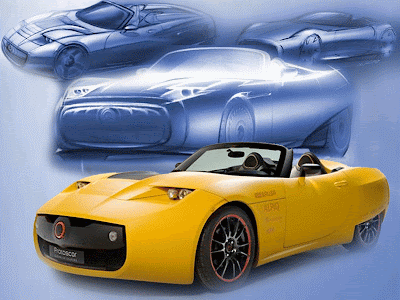
LAMPO2 is an electric demonstration sports car conceived by Protoscar, a Swiss company which has been developing CleanCar projects for 23 years including consulting of OEMs, power utilities and governments. The LAMPO2 boasts 'quick-charging' capability (up to 100 km range extension in just 10 minutes charging time) and will be presented at the Geneva Motor Show (2nd March 2010) on the e'mobile stand Nr. 5141.

2010 LAMPO2 Electric Sports Car Protoscar Concept
LAMPO2 is an even more energy efficient successor to the LAMPO demonstration vehicle presented in 2009. Weight, aerodynamics and the efficiency of individual components of the BRUSA drive train have been further optimized in order to reach a world-class energy consumption of less than 100Wh/km-ton under real conditions. LAMPO2 is equipped with 4 different charging modes:
• standard single-phase with up to 3,3kW on board charger for typical overnight home-charge,
• 'control-pilot' equipped and (EDF provided) PLC single-phase with 6,6kW on board charger typical for public charging,

2010 LAMPO2 Electric Sports Car Protoscar Concept
• standard three-phase 9,9kW on board charger typical for charging at industrial plugs (fleet-owners) and
• an interface for DC fast charging (able to transmit a max. power of 80kW), where up to 100km of additional range can be charged within just 10 minutes, by an off-board system, so that the different solutions can be compared in terms of usability and efficiency by being demonstrated in real conditions.

2010 LAMPO2 Electric Sports Car Protoscar Concept
LAMPO2 will be shown together with different charging infrastructure solutions: a smart home charge device (developed with ALPIQ), the public charging station E-TOTEM and the quick-charging station (developed with ABB and Brusa).

2010 LAMPO2 Electric Sports Car Protoscar Concept
LAMPO2 impressively demonstrates that electric drive-trains are mature and perform sufficiently well to be a solution for all types of vehicles, not just city cars. This includes premium cars, the segment through which most new technologies have successfully been introduced into the market.

2010 LAMPO2 Electric Sports Car Protoscar Concept
Together with the first LAMPO (which has already been driven over 10'000 km on race tracks and public roads across Europe), LAMPO2 will be used for practical demonstrations and testing. Protoscar has repeatedly been encouraged to develop an advanced electric cabriolet for small-scale production and plans to use the LAMPO2 to evaluate this possibility. The evaluation will include discussions with potential industrial and financial partners, and an assessment of the preferences and desires of potential clients. Lampo crossing the Gotthard pass in May 2009.

2010 LAMPO2 Electric Sports Car Protoscar Concept
In addition to BRUSA, which supplies the components of the whole drive train, the main partners and sponsors of the LAMPO2 project are ALPIQ (the leading Swiss company in power generation and distribution, which is actively promoting the goal of 15% of electric vehicles in Switzerland by 2020), the German Fraunhofer Institute IAO (EV-specific features and MMI, as well as optimization of the ergonomics), ABB (DC fast-charging technology) and the Swiss Federal Office of Energy.

2010 LAMPO2 Electric Sports Car Protoscar Concept
Technical details LAMPO2 has two electric motors (allowing it to operate as a four-wheel drive with variable torque between front and rear axle for optimal handling, safety and efficiency) with a total output of 260 kW (equivalent to 350 HP), 600 Nm (50% more than its predecessor!) and over 30 kWh of Lithium-Ion battery capacity. LAMPO2 features real sports-car performances: 5 seconds to accelerate from 0 to 100 km/h, 200 km/h of max. speed and a range of over 200 km. More than enough energy for driving is produced by a remote solar plant which is installed on the roof of a farm in Tuscany, allowing a real zero-emission drive on a 'Well-to-Wheel' basis.
Source - Protoscar
2010 LAMPO2 Electric Sports Car Protoscar Concept
LAMPO2 is an electric demonstration sports car conceived by Protoscar, a Swiss company which has been developing CleanCar projects for 23 years including consulting of OEMs, power utilities and governments. The LAMPO2 boasts 'quick-charging' capability (up to 100 km range extension in just 10 minutes charging time) and will be presented at the Geneva Motor Show (2nd March 2010) on the e'mobile stand Nr. 5141.
2010 LAMPO2 Electric Sports Car Protoscar Concept
LAMPO2 is an even more energy efficient successor to the LAMPO demonstration vehicle presented in 2009. Weight, aerodynamics and the efficiency of individual components of the BRUSA drive train have been further optimized in order to reach a world-class energy consumption of less than 100Wh/km-ton under real conditions. LAMPO2 is equipped with 4 different charging modes:
• standard single-phase with up to 3,3kW on board charger for typical overnight home-charge,
• 'control-pilot' equipped and (EDF provided) PLC single-phase with 6,6kW on board charger typical for public charging,
2010 LAMPO2 Electric Sports Car Protoscar Concept
• standard three-phase 9,9kW on board charger typical for charging at industrial plugs (fleet-owners) and
• an interface for DC fast charging (able to transmit a max. power of 80kW), where up to 100km of additional range can be charged within just 10 minutes, by an off-board system, so that the different solutions can be compared in terms of usability and efficiency by being demonstrated in real conditions.
2010 LAMPO2 Electric Sports Car Protoscar Concept
LAMPO2 will be shown together with different charging infrastructure solutions: a smart home charge device (developed with ALPIQ), the public charging station E-TOTEM and the quick-charging station (developed with ABB and Brusa).
2010 LAMPO2 Electric Sports Car Protoscar Concept
LAMPO2 impressively demonstrates that electric drive-trains are mature and perform sufficiently well to be a solution for all types of vehicles, not just city cars. This includes premium cars, the segment through which most new technologies have successfully been introduced into the market.
2010 LAMPO2 Electric Sports Car Protoscar Concept
Together with the first LAMPO (which has already been driven over 10'000 km on race tracks and public roads across Europe), LAMPO2 will be used for practical demonstrations and testing. Protoscar has repeatedly been encouraged to develop an advanced electric cabriolet for small-scale production and plans to use the LAMPO2 to evaluate this possibility. The evaluation will include discussions with potential industrial and financial partners, and an assessment of the preferences and desires of potential clients. Lampo crossing the Gotthard pass in May 2009.
2010 LAMPO2 Electric Sports Car Protoscar Concept
In addition to BRUSA, which supplies the components of the whole drive train, the main partners and sponsors of the LAMPO2 project are ALPIQ (the leading Swiss company in power generation and distribution, which is actively promoting the goal of 15% of electric vehicles in Switzerland by 2020), the German Fraunhofer Institute IAO (EV-specific features and MMI, as well as optimization of the ergonomics), ABB (DC fast-charging technology) and the Swiss Federal Office of Energy.
2010 LAMPO2 Electric Sports Car Protoscar Concept
Technical details LAMPO2 has two electric motors (allowing it to operate as a four-wheel drive with variable torque between front and rear axle for optimal handling, safety and efficiency) with a total output of 260 kW (equivalent to 350 HP), 600 Nm (50% more than its predecessor!) and over 30 kWh of Lithium-Ion battery capacity. LAMPO2 features real sports-car performances: 5 seconds to accelerate from 0 to 100 km/h, 200 km/h of max. speed and a range of over 200 km. More than enough energy for driving is produced by a remote solar plant which is installed on the roof of a farm in Tuscany, allowing a real zero-emission drive on a 'Well-to-Wheel' basis.
Source - Protoscar
Thursday, 11 February 2010
Maserati Electric Supercar Tramontane Concept
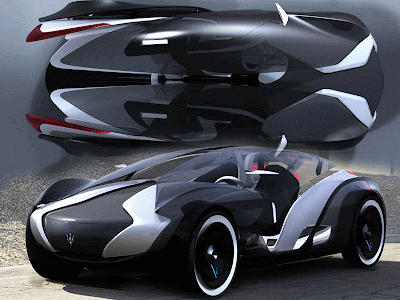
Maserati Electric Supercar Tramontane Concept
The Maserati Tramontane Concept is a luxury electric supercar with a futuristic design characterized by flowing elements that form different layers and interconnect the exterior and the interior. The author is Czech design student Ondrej Jirec.
The Maserati Tramontane is a lightweight electric luxury supercar with an original design focused on the reduction of the total number of body parts and the simplification of the production process by combining exterior and interior elements.

Maserati Electric Supercar Tramontane Concept
Aside from the slippery, aerodynamic overall shape, the most eye-catching aspect of the concept's design is the number of components and body panels which flow from the interior to the exterior. These body parts have different functions, color, material and characteristics which are designed to add different dimensions and effect the overall feel of the vehicle.

Maserati Electric Supercar Tramontane Concept
It was created by Czech student Ondrej Jirec for his Alias class at the Art Center College of Design. Among the distinctive features of the Maserati Tramontane's design are the components and body panels which flow from the interior to the exterior. These parts have different function, color, material and characteristics and create layers that add different "dimensions" and define an original design language.
The first layer is the main glass exterior surface that essentially envelops the entire car. It is supported by a black frame which attaches to the chassis.

Maserati Electric Supercar Tramontane Concept
The second layer is composed of the headlamps and the dashboard. This single piece carries the LED headlights and flows smoothly back into the interior where it protects the speakers and interior air vents.
The third layer of the Tramontane creates the lower sections of the seats and, as it reaches the exterior, also carries the taillights. This particular part possesses very high resistance to impact. In case of side impact the seat and chassis work together to protect the occupants. But in the event of a rear collision, this part contains a crumple zone that will collapse, so the seats remain protected.

Maserati Electric Supercar Tramontane Concept
The fourth layer, placed in the front, serves as a housing for the electric motor and also as a dashboard. This element is attached to the chassis and hides the motor, frame, and all the electronics.
Having its length at 4,250mm, Tramontane is just 50mm shorter in length to Lamborghini Gallardo. Its height is 1,170mm which is almost the same as that of Gallardo’s. Its front wheels are driven by an electric motor, whereas the rear ones have an electric motor for each.

Maserati Electric Supercar Tramontane Concept
The most striking facet of its design is the number of components and body panels that smoothly move from interior to the exterior. Its parts have different functions, color, material and characteristics that aid more to the overall feel of the vehicle.
The proposed drivetrain for the concept is an all-electric setup. The front wheels are driven by one electric motor, while the rear wheels each get their own motor.
Maserati Electric Supercar Tramontane Concept
Maserati Electric Supercar Tramontane Concept
The Maserati Tramontane Concept is a luxury electric supercar with a futuristic design characterized by flowing elements that form different layers and interconnect the exterior and the interior. The author is Czech design student Ondrej Jirec.
The Maserati Tramontane is a lightweight electric luxury supercar with an original design focused on the reduction of the total number of body parts and the simplification of the production process by combining exterior and interior elements.
Maserati Electric Supercar Tramontane Concept
Aside from the slippery, aerodynamic overall shape, the most eye-catching aspect of the concept's design is the number of components and body panels which flow from the interior to the exterior. These body parts have different functions, color, material and characteristics which are designed to add different dimensions and effect the overall feel of the vehicle.
Maserati Electric Supercar Tramontane Concept
It was created by Czech student Ondrej Jirec for his Alias class at the Art Center College of Design. Among the distinctive features of the Maserati Tramontane's design are the components and body panels which flow from the interior to the exterior. These parts have different function, color, material and characteristics and create layers that add different "dimensions" and define an original design language.
The first layer is the main glass exterior surface that essentially envelops the entire car. It is supported by a black frame which attaches to the chassis.
Maserati Electric Supercar Tramontane Concept
The second layer is composed of the headlamps and the dashboard. This single piece carries the LED headlights and flows smoothly back into the interior where it protects the speakers and interior air vents.
The third layer of the Tramontane creates the lower sections of the seats and, as it reaches the exterior, also carries the taillights. This particular part possesses very high resistance to impact. In case of side impact the seat and chassis work together to protect the occupants. But in the event of a rear collision, this part contains a crumple zone that will collapse, so the seats remain protected.
Maserati Electric Supercar Tramontane Concept
The fourth layer, placed in the front, serves as a housing for the electric motor and also as a dashboard. This element is attached to the chassis and hides the motor, frame, and all the electronics.
Having its length at 4,250mm, Tramontane is just 50mm shorter in length to Lamborghini Gallardo. Its height is 1,170mm which is almost the same as that of Gallardo’s. Its front wheels are driven by an electric motor, whereas the rear ones have an electric motor for each.
Maserati Electric Supercar Tramontane Concept
The most striking facet of its design is the number of components and body panels that smoothly move from interior to the exterior. Its parts have different functions, color, material and characteristics that aid more to the overall feel of the vehicle.
The proposed drivetrain for the concept is an all-electric setup. The front wheels are driven by one electric motor, while the rear wheels each get their own motor.
Tuesday, 9 February 2010
New Mégane Coupé Cabriolet with Elegant Interior Design
 New Mégane Coupé-Cabriolet completes the renewal style of the New Mégane family which is built on the strengths that forged the success of its predecessor. Its new appearance is supported by the large folding glass roof, high-gloss finish, black glass roof contrasts with the satin-effect chrome windscreen frame exterior, and the dark red taillights featuring a linear lighting pattern and LED brake lights to provide a distinctive rear lighting character.
With it’s new style, New Mégane Coupé-Cabriolet goes further by offering customers with unruffled open-top motoring supported by the forward position of the windscreen and a fixed glass, outstanding handling performance with a stiffer chassis and a new electric power steering system, and a broad choice of efficient and eco-friendly powertrains including the all-new automatic EDC (Efficient Dual Clutch) transmission.

 The interior of this New Mégane family still presents the same layout with high standard finish of qualified materials available in three choices of trim, which range from dark charcoal and light beige to the charcoal and red two-tone finish with leather seats. Although the dashboard is identical to that of New Mégane Hatchback, the seats offer additional lateral support, while the ‘butterfly wing’ door trim panel is specific to New Mégane Coupé-Cabriolet.
 New Mégane Coupé-Cabriolet is available with a choice of seven efficient and eco-friendly petrol and diesel powertrain configurations (depending on the market). The available petrol engines are, the 1.6 16V 110hp engine mated to a six-speed manual gearbox, the TCe 130 (Turbo Control efficiency) driving through a six-speed manual gearbox, and the 2.0 16V 140hp engine available with the new continuously variable transmission (CVT) for even greater driving comfort thanks to smooth, step-less gearshifts. While the diesel engine range, which comprises the Euro5-homologated powerplants are the dCi 110 DPF, mated either to the brand new six-speed EDC (Efficient Dual Clutch) dual-clutch automatic transmission (see below) or to a manual six-speed gearbox, the dCi 130 DPF which drives through a six-speed manual gearbox, and the dCi 160 DPF also with a six-speed manual gearbox.
 Public will get their first opportunity to see this New Mégane Coupé-Cabriolet when it is unveiled at the forthcoming Geneva Motor Show (March 4-14). It will also be displayed at L’Atelier Renault on the Champs-Elysées in Paris.
 Rounding off the new Megane family is the Coupe-Cabriolet that was formally introduced today ahead of its world premiere at next month's Geneva Salon. Like its predecessor, the new Megane CC is a two door model with an electric folding top that's mostly covered in smoked glass
The French carmaker claims the Megane CC's transparent glazed area of 0.47 sq. metres is the largest in the segment that includes cars like the Pininfarina-styled Ford Focus CC and the Peugeot 308 CC.
 The four-seater convertible version of the new Megane also gets a fixed glass wind deflector located behind the back seat headrests that is said to allow draft-free driving at speeds of up to 90km/h or 56mph.
 The fully-automatic, electro-hydraulic operated two-piece glass top goes up or down in 21 seconds at the press of a button with the Megane CC's boot capacity standing at 417 litres with the roof closed, and 211 litres when open.
Depending on the market, the new Megane Coupe-Cabriolet will be available with a choice of up to seven gasoline and diesel powertrains.
The petrol line includes a 110HP 1.6-liter unit linked to a six-speed manual, a 1.4-liter TCe turbo with 130HP matted to a six-speed manual and a 140HP 2.0-liter with a CVT.
 Diesel options include the 110HP dCi matted to either a new 6-speed dual clutch automatic transmission or to 6-speed manual gearbox and the 130HP dCi and 160HP dCi that both drive the front wheels through a six-speed manual.
European sales of next generation Megane Coupe-Cabriolet will begin this spring.

 Interior design of megane cabrioet pict images


New Peugeot 207 S16 Special Edition 2010

2010 Peugeot 207 S16 Special Edition - Rear Side View
This Picture for new Peugeot 207 S16 Special Edition is a limited run that will be exclusive to the UK. Anyone from the UK will be able to appreciate the colors here that are used on the paint job. It will come with front and rear spoilers, aerodynamic side skirts, and a faux rear diffuser.Peugeot has created the Special Edition 207 S16 which is based on the 207 Sport 1.6 VTi 3dr, only 250 examples of this car will be produced. The S16 adds to the already comprehensive standard equipment of the 207 sport model: Bianca White exterior body colour, Full 207 RC Cup bodykit comprising front and rear spoilers, side skirts and a pseudo rear diffuser, 17″ Hockenheim Alloy Wheels, SP Sports mesh grille, Dark tinted rear windows from the 207 GTi model, Special interior badge signed by Kris Meeke, Optional free of charge vinyl rally graphics which mimic those found on Kris Meeke’s IRC winning 207 S2000 rally car.
The 207 S16 benefits from over £1,200 worth of additional specification compared to a standard Car Sport model and is priced at £14,695.

2010 Peugeot 207 S16 Special Edition - Front Side View
To further enhance the appeal of the 207 S16 an optional leather interior is also available priced at £684.21. It is available in black with either black or silver Grey stitching.
Subscribe to:
Posts (Atom)


