

Tuesday, 12 January 2010

Volare The Aston Martin Sports Car Concept is an eco-friendly

Aston Martin Volare is an eco-friendly

The Aston Martin Volare is a proposal for a next-generation Aston Martin supercar which features an environmentally friendly drivetrain. Aston Martin, like all other supercar manufacturers, faces a dilemma over the next decade; How to dramatically reduce the carbon footprint of their vehicles while also maintaining performance levels which are equal, or superior, to past models.
 
Volare The Aston Martin Sports Car Concept

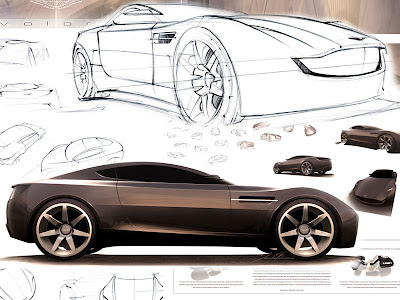
The Aston Martin Volare is a design study of a two-seater sportscar that combines the typical styling cues of the brand with a fuel-cell powertrain and an interior characterized by the use of eco-friendly materials. The author is Coventry graduate James Trim. The two-seater Aston Martin Volare Concept features a high-power fuel cell stack, located between the front seats, a rear mounted battery pack, and a co-axial electric motor at the front. To aid the Volare’s weight distribution, the two hydrogen storage tanks have been positioned directly above the car’s rear axle. The Aston Martin Volare concept was a vehicle developed by James Trim during his final year at Coventry University studying Automotive Design. He is currently looking for placement opportunities.
Volare The Aston Martin Sports Car Concept 

Speaking about the exterior design of the concept, James Trim explains, "The underlying aim when designing the Volare was to combine present day technologies with the profile of a car that would be instantaneously recognisable as that of an Aston Martin."
Trim said of the design; “Aesthetically the vehicle sharpens up the familiar Aston Martin proportions, with much crisper shoulders and a noticeable ‘floating’ rear deck. The solid front grille was inspired by the older V8 Vantage, while the flexible front fenders can alter their shape to reveal daytime running lights or full headlamps.”
Volare The Aston Martin Sports Car Concept 

The interior uses eco-friendly leather. The materials used in the tanning process are derived from sustainable, farm bred, Mimosa trees. The natural extract from the trees is used to produce the chemicals necessary for farming leather.
This results in an enironmentally-friendly natural process, producing breathable and highly flexible hides. The center console is made from recycled aluminium. The emerging binnacle and Bang & Olufsen twin lens speakers add a touch of theatre to the cabin. "The principle concern being confronted by Aston Martin is the harmful impact their cars are having on the environment. With this in mind, the Aston Martin Volare retains the fantastic sound and outright performance customary with that of a gasoline equivalent.
Volare The Aston Martin Sports Car Concept  

Side from the eco-friendly drivetrain, another dictating factor in the Volare’s design was the desire to create a car which was instantly recognizable as an Aston Martin. It was important that the styling was influenced more by the heritage of the brand, rather than the source of power. On the Volare concept all the hallmarks of Aston Martin are instantly apparent, sleek profile, short front and rear overhangs, trademark grille, powerful rear arches and uncluttered lines.

Volare The Aston Martin Sports Car Concept is an eco-friendly

Aston Martin Volare is an eco-friendly

The Aston Martin Volare is a proposal for a next-generation Aston Martin supercar which features an environmentally friendly drivetrain. Aston Martin, like all other supercar manufacturers, faces a dilemma over the next decade; How to dramatically reduce the carbon footprint of their vehicles while also maintaining performance levels which are equal, or superior, to past models.
 
Volare The Aston Martin Sports Car Concept

The Aston Martin Volare is a design study of a two-seater sportscar that combines the typical styling cues of the brand with a fuel-cell powertrain and an interior characterized by the use of eco-friendly materials. The author is Coventry graduate James Trim. The two-seater Aston Martin Volare Concept features a high-power fuel cell stack, located between the front seats, a rear mounted battery pack, and a co-axial electric motor at the front. To aid the Volare’s weight distribution, the two hydrogen storage tanks have been positioned directly above the car’s rear axle. The Aston Martin Volare concept was a vehicle developed by James Trim during his final year at Coventry University studying Automotive Design. He is currently looking for placement opportunities.
Volare The Aston Martin Sports Car Concept 

Speaking about the exterior design of the concept, James Trim explains, "The underlying aim when designing the Volare was to combine present day technologies with the profile of a car that would be instantaneously recognisable as that of an Aston Martin."
Trim said of the design; “Aesthetically the vehicle sharpens up the familiar Aston Martin proportions, with much crisper shoulders and a noticeable ‘floating’ rear deck. The solid front grille was inspired by the older V8 Vantage, while the flexible front fenders can alter their shape to reveal daytime running lights or full headlamps.”
Volare The Aston Martin Sports Car Concept 

The interior uses eco-friendly leather. The materials used in the tanning process are derived from sustainable, farm bred, Mimosa trees. The natural extract from the trees is used to produce the chemicals necessary for farming leather.
This results in an enironmentally-friendly natural process, producing breathable and highly flexible hides. The center console is made from recycled aluminium. The emerging binnacle and Bang & Olufsen twin lens speakers add a touch of theatre to the cabin. "The principle concern being confronted by Aston Martin is the harmful impact their cars are having on the environment. With this in mind, the Aston Martin Volare retains the fantastic sound and outright performance customary with that of a gasoline equivalent.
Volare The Aston Martin Sports Car Concept  

Side from the eco-friendly drivetrain, another dictating factor in the Volare’s design was the desire to create a car which was instantly recognizable as an Aston Martin. It was important that the styling was influenced more by the heritage of the brand, rather than the source of power. On the Volare concept all the hallmarks of Aston Martin are instantly apparent, sleek profile, short front and rear overhangs, trademark grille, powerful rear arches and uncluttered lines.

Peugeot RC Spades 2002


2010 Subaru Impreza Concept

The Subaru Impreza Concept fuses a sleek form that exudes dynamism and elegance with a roomy and rich four-seat interior that expresses a safe and comfortable ride. The car suggests an advanced design for Subaru by using a sporty and lively four-door coupe style.

The A-pillar stretching forward and the smoothly flowing C-pillar are important elements provide both a roomy cabin and also superlative aerodynamic performance.
The front design, seen in combination with the traditional hawk eye-style headlights, this striking, unique design presents a front face instantly recognizable as a Subaru. A fin-shaped fog lamp is also featured in the front bumper. Following on the Subaru wing motif, it gives an even fresher expression of the Subaru identity.
The rear design, the rear lights create a sharp impression, with an edged design that stretches to the body side and joins with the body character line. For the diffusers on the underside of the rear bumper and the rear deck, Subaru has employed a design that capitalizes on aerodynamic characteristics with satisfying environmental friendliness.
The high-luster silver aluminum wheels use a 10-spoke design consisting of five sturdy spokes that evoke the powerful AWD driving experience and five thin spokes that evoke the lightness of the Impreza. Carbon fins garnish the circumference of the spokes, demonstrating their brake-cooling performance. The exterior color is “Sky Silver.” This bluish silver suggests an airplane in flight.
This dynamic shape of Subaru Impreza Concept’s interior brings together the instrument panel with the door trim and armrests, and speaks to the driving pleasure that is expected from Subaru. The roomy platinum-leather four-seat layout enfolds occupants. The leather was chosen to fit in with the interior color motif and give passengers the impression of urbanity and coolness. Dark blue piping and double stitching was used in the interior. The upper part is of a light platinum color, while the lower part is shade darker.
In interior is equipment more features information and entertainment. Three different displays – one each for navigation, car audio and vehicle information. The sporty steering wheel and A monitor in the combination meter displays video from the EyeSight Stereo Camera.
The Subaru Impreza Concept is powered by a next-generation Horizontally-Opposed Boxer engine with improved environmental friendliness. The combination of the 2.0-liter naturally-aspirated Boxer engine with a Lineartronic (CVT) represents Subaru’s next-generation powertrain.
Technical Specifications
  • Length: 178.0″
  • Width: 71.7″
  • Height: 56.3″
  • Wheelbase: 103.9 inches
  • Engine: 2.0-liter four cylinder Horizontally-Opposed engine
  • Transmission: Lineartronic (CVT)
  • Tire size: 245/40ZR19
  • Occupancy: Four persons
Subaru Impreza Concept interior
Subaru Impreza Concept
source :carshowp.com

Monday, 11 January 2010

Profil Peugeot 206 Luigiturbo


Profil Peugeot 206 Luigiturbo:

MAKE & MODEL :Peugeot 206,YEAR 2003,DISPLACEMENT 0 ccm,CONFIGURATION R4 Turbo,POWER 0 0,TORQUE 0 @ 0,WEIGHT N/A Kilos,0-60 MPH N/A sec
TYRE-SIZE/MAKE N/A,WHEEL-SIZE/MAKE N/A,ENGINE Sconosciuto,TRANSMISSION Sconosciuto,UNDERCARRIAGE Sconosciuto,BRAKES Sconosciuto,EXTERIOR Sconosciuto,INTERIOR Sconosciuto,ICE Sconosciuto

2010 Audi e-tron Sports Car Concept with "MMI touch"

2010 Audi e-tron Sports Car Concept
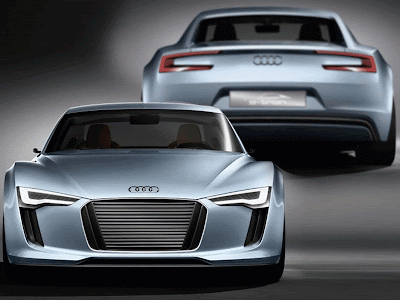
 The Detroit Audi e-tron Concept is 3.93 meter (154.72 in) long and 1.78 meter (70.08 in) wide but just 1.22 meter (48.03 in) tall two-seater; just a few months after the debut of the Audi e-tron Concept at the 2009 Frankfurt Motor Show, this is now the second electric concept vehicle from the brand with the four rings. Audi is showing an uncompromising purist compact sports car with all-electric drive at the 2010 NAIAS. Lithium-ion batteries, located for an optimal center of gravity behind the passenger compartment and ahead of the rear axle, make an effective energy content of 45 kilowatt-hours available. This makes an operating range of up to 250 kilometers (155.34 miles) realistically possible. 

2010 Audi e-tron Sports Car Concept

Coupled with the Detroit Audi e-tron Concept's low gross weight of around only 1,350 kilograms (2976.24 lb), high-torque power units driving the rear wheels guarantee commensurate road performance. Two electric motors with a combined output of 150 kW (204 hp) and 2,650 Nm (1954.54 lb-ft) accelerate the coupe with ASF-design aluminum body from 0 to 100 km/h (62.14 mph) in just 5.9 seconds. The Audi e-tron Concept accomplishes the sprint from 60 to 120 km/h (37.28 - 74.56 mph) in a mere 5.1 seconds.
As previously with the first Audi e-tron Concept car shown in Frankfurt, Audi again bases all components in this electric vehicle on an integral concept with many revolutionary details: a heat pump as an efficient means of heating up and maintaining the interior temperature. The drive system, power electronics and battery have innovative thermal management - crucial for maintaining a high operating range coupled with outstanding interior comfort.
2010 Audi e-tron Sports Car Concept 

The two electric motors, which have their own cooling system, are mounted on the rear axle. This special package, featuring a 40:60 weight distribution, ensures perfect balance, which contributes to the driving dynamics of the Audi e-tron Concept.
The trapeze of the single-frame grille dominates the distinctly wedge-shaped front end and is flanked by two large air intakes. The top of the grille merges into the flat strips of the adaptive matrix beam headlight modules with their clear glass covers. All light units use ultra-efficient LED technology.
One design element that is specific to electric vehicles developed by Audi - such as the Audi e-tron - are the air intakes in the single-frame grille and behind the side windows on the C-post. They are closed flush under normal circumstances and opened by retracting slats when additional cooling air is required. The slats above the drive unit then also open to provide a better through-flow of air. These measures, too, maximize efficiency - the concept car is outstanding for an already low drag coefficient that is further improved when the flaps are closed.
2010 Audi e-tron Sports Car Concept 

The combination of aluminum and carbon fiber-reinforced composite material guarantees supreme rigidity coupled with low weight. Audi will soon use this technology in a similar form for future production vehicles. Despite the complex drive system layout with two electric motors and a high-capacity battery system, the total weight of the Audi e-tron Concept on display in Detroit is only around 1,350 kilograms (2,976.24 lb).
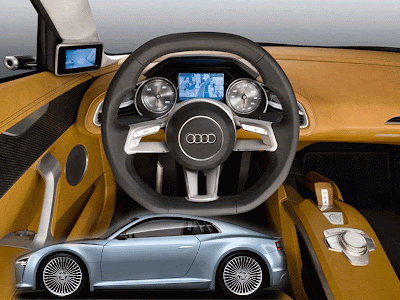
The MMI is controlled via a scroll pad with a touch-sensitive surface on the steering wheel ("MMI touch") - an element inspired by modern smartphones. The steering wheel itself is clearly flattened off at both the top and bottom, in a clear reference to motor sport.
A smartphone that can be integrated into the front section of the center console interfaces between the vehicle, the driver and external information sources. The driver can use a suitably equipped conventional smartphone as a car phone, address database, navigation system and video player. At the same time they can also use it as an operating unit for many specific on-board systems in the Audi e-tron Concept. Many phones that are suitable for these functions are already available from various manufacturers.
2010 Audi e-tron Sports Car Concept 

Characteristic for the concept of the Audi e-tron - and therefore also characteristic for a further development in an electric vehicle - is the near total elimination of switches and small components such as the ignition. The climate control unit is located to the right above the steering wheel. The display provides temperature and ventilation information. Again drawing inspiration from a smartphone, the system is controlled by means of a touch-sensitive sliding control.

2010 Audi e-tron Sports Car Concept with "MMI touch"

2010 Audi e-tron Sports Car Concept
 The Detroit Audi e-tron Concept is 3.93 meter (154.72 in) long and 1.78 meter (70.08 in) wide but just 1.22 meter (48.03 in) tall two-seater; just a few months after the debut of the Audi e-tron Concept at the 2009 Frankfurt Motor Show, this is now the second electric concept vehicle from the brand with the four rings. Audi is showing an uncompromising purist compact sports car with all-electric drive at the 2010 NAIAS. Lithium-ion batteries, located for an optimal center of gravity behind the passenger compartment and ahead of the rear axle, make an effective energy content of 45 kilowatt-hours available. This makes an operating range of up to 250 kilometers (155.34 miles) realistically possible. 

2010 Audi e-tron Sports Car Concept

Coupled with the Detroit Audi e-tron Concept's low gross weight of around only 1,350 kilograms (2976.24 lb), high-torque power units driving the rear wheels guarantee commensurate road performance. Two electric motors with a combined output of 150 kW (204 hp) and 2,650 Nm (1954.54 lb-ft) accelerate the coupe with ASF-design aluminum body from 0 to 100 km/h (62.14 mph) in just 5.9 seconds. The Audi e-tron Concept accomplishes the sprint from 60 to 120 km/h (37.28 - 74.56 mph) in a mere 5.1 seconds.
As previously with the first Audi e-tron Concept car shown in Frankfurt, Audi again bases all components in this electric vehicle on an integral concept with many revolutionary details: a heat pump as an efficient means of heating up and maintaining the interior temperature. The drive system, power electronics and battery have innovative thermal management - crucial for maintaining a high operating range coupled with outstanding interior comfort.
2010 Audi e-tron Sports Car Concept 

The two electric motors, which have their own cooling system, are mounted on the rear axle. This special package, featuring a 40:60 weight distribution, ensures perfect balance, which contributes to the driving dynamics of the Audi e-tron Concept.
The trapeze of the single-frame grille dominates the distinctly wedge-shaped front end and is flanked by two large air intakes. The top of the grille merges into the flat strips of the adaptive matrix beam headlight modules with their clear glass covers. All light units use ultra-efficient LED technology.
One design element that is specific to electric vehicles developed by Audi - such as the Audi e-tron - are the air intakes in the single-frame grille and behind the side windows on the C-post. They are closed flush under normal circumstances and opened by retracting slats when additional cooling air is required. The slats above the drive unit then also open to provide a better through-flow of air. These measures, too, maximize efficiency - the concept car is outstanding for an already low drag coefficient that is further improved when the flaps are closed.
2010 Audi e-tron Sports Car Concept 

The combination of aluminum and carbon fiber-reinforced composite material guarantees supreme rigidity coupled with low weight. Audi will soon use this technology in a similar form for future production vehicles. Despite the complex drive system layout with two electric motors and a high-capacity battery system, the total weight of the Audi e-tron Concept on display in Detroit is only around 1,350 kilograms (2,976.24 lb).
The MMI is controlled via a scroll pad with a touch-sensitive surface on the steering wheel ("MMI touch") - an element inspired by modern smartphones. The steering wheel itself is clearly flattened off at both the top and bottom, in a clear reference to motor sport.
A smartphone that can be integrated into the front section of the center console interfaces between the vehicle, the driver and external information sources. The driver can use a suitably equipped conventional smartphone as a car phone, address database, navigation system and video player. At the same time they can also use it as an operating unit for many specific on-board systems in the Audi e-tron Concept. Many phones that are suitable for these functions are already available from various manufacturers.
2010 Audi e-tron Sports Car Concept 

Characteristic for the concept of the Audi e-tron - and therefore also characteristic for a further development in an electric vehicle - is the near total elimination of switches and small components such as the ignition. The climate control unit is located to the right above the steering wheel. The display provides temperature and ventilation information. Again drawing inspiration from a smartphone, the system is controlled by means of a touch-sensitive sliding control.