






Tuesday, 20 October 2009
Honda Civic Type S photo gallery
Honda Civic Type S 2007 Civic Type S 1.4i VTEC 3drHonda Civic Type SHonda Civic Type S2007 Honda Civic Type S Honda Civic Type SHonda Civic Type SHonda Civic Type SHonda Civic Type SHonda Civic Type S UKHonda Civic Type S2002 Honda Civic Type SHonda Civic Type SHonda Civic Type S2007 Honda Civic Type S Honda Civic Type S Honda Civic Type SHonda Civic Type SHonda Civic Type SHonda Civic Type

Sunday, 18 October 2009
2010 Ferrari 458 Italia Live Image


The Ferrari 458 Italia, that debuts today at the IAA Frankfurt Motor Show, is an 8-cylinder two-seater berlinetta with a mid-rear mounted engine, and represents a genuine break with the past in terms of Maranello’s previous high-performance sports cars. Designed to fulfil the expectations and ambitions of our most passionate clients, the 458 Italia continues the Ferrari tradition of putting the thrill into driving as a result of track-derived technological innovations.
Maranello’s racing experience can be felt not only in terms of pure technological transfer but also on a more emotional level, because of the strong emphasis on creating an almost symbiotic relationship between driver and car. This is one of the areas where Michael Schumacher’s contribution, right from the early stages of the project, was of fundamental importance.
Thanks to a new 4,499 cc V8 engine, which punches out 570 CV, the F1 dual-clutch gearbox and a 1,380 kg dry weight, the 458 Italia boasts an extraordinary weightpower ratio of 2.42 kg (a power-weight ratio of 413 CV per ton). This means it sprints from 0 to 100 km/h in under 3.4 seconds and hits a maximum speed of over 325 km/h.
The 458 Italia delivers superb vehicle dynamics with an ideal weight balance for a midrear engined sports car – 58 per cent rear, 42 per cent front. Evolved electronic control systems also help guarantee maximum performance in all driving conditions. Its new suspension set-up, featuring twin wishbones with L arms at the front and a multilink set-up the rear, is tuned for ultimate road-holding and superlative handling. This, together with a more direct steering ratio, ensures the car is extremely responsive whilst maintaining superior ride comfort.
As is the case with the Scuderia’s Formula 1 single-seaters, the engineers focused their efforts on achieving maximum efficiency right across the board with this car. The result is that the Ferrari 458 Italia produces only 307 g/km of CO2 and has a fuel consumption of just 13.3 l/100 km (combined cycle), a benchmark for the entire segment.
Aside from the work done to reduce both internal friction in the engine and overall weight, this result has been achieved thanks to aerodynamic research which focused on cutting drag and maximising downforce.
The 458 Italia is thus a synthesis of technological innovation, creative flair, style and passion, a combination of characteristics for which Italy as a nation is renowned. Ferrari’s Chairman, Luca di Montezemolo, chose to pay homage to this fact by adding the name of the car’s homeland to the traditional figure representing the displacement and number of cylinders.
Styling and aerodynamics
Every Ferrari is the result of an uncompromising design approach that integrates styling and aerodynamic requirements. The Pininfarina design features compact, aerodynamic lines, underscoring the concepts of performance-oriented efficiency that inspired the project.
The nose features a single opening for the front grille and side air intakes, with aerodynamic sections and profiles designed to direct air to the coolant radiators and the new flat underbody. The nose also sports small aeroelastic winglets which generate downforce and, as speed rises, deform to reduce the section of the radiator intake and cut drag.
The oil radiators for the F1 gearbox and the dual-clutch are situated in the tail and air is fed from two intakes on the top of the rear wings. This solution provides a base bleed effect, an aerodynamic function that was developed by Ferrari for the FXX and which reduces drag by feeding the hot air out of the radiators under the nolder and into the slip stream. Using experience gained in aerodynamic development on the Ferrari F430 GT2, the flat underbody now incorporates the air intakes for engine bay cooling. These are positioned ahead of the rear wheelarches where they use pressure differences to efficiently channel air flow to the engine bay, at the same time generating more rear downforce.
The car’s sills are characterised by two keel forms that act as fairings to the rear wheels, while the rear bodywork between the rear diffusers acts as the surround to the novel triple exhaust tail pipes, a styling cue that recalls the legendary F40 and gives the 458 Italia’s tail an aggressive sporty stance. The engine, in mid-rear V8 Ferrari tradition, is visible below the engine cover.
Technical development of the car’s shape started using CFD (Computational Fluid- Dynamic) techniques which helped optimise the management and interaction of the internal flows prior to wind tunnel testing. The latter was carried out on Ferrari’s rolling road facility using modular 1:3 scale models. The final solution chosen ensured adequate cooling to the running gear, while, at the same time, achieving a high level of aerodynamic efficiency (1.09) through excellent drag and downforce figures (Cd 0.33 and Cl 0.36 respectively) with 140 kg of downforce at 200 km/h and no less than 360 kg at top speed.
The front-mounted coolant radiators are trapezoidal in shape and positioned to minimise the impact of the internal cooling flows on drag and downforce. The oil radiators for the gearbox and clutch are are situated in the tail with air fed from two intakes on the top of the rear wings. The hot air from the radiators creates a base bleed effect, venting into the car’s low-pressure trail below the nolder and reducing drag.
The air intakes for engine bay cooling are situated on the aerodynamic underbody, where differences in pressure channel the air in the most efficient manner, and are positioned to increase rear downforce. Similarly air is channelled from the front air dam to the rear diffuser where the position and number of the fences has been developed to optimise the distribution of the vortex to improve rear downforce.
Engine
The engine is a dry-sump 90 degree V8 with a displacement of 4499 cc and is mid-rear mounted. It is an entirely new design engineered to reach a maximum of 9,000 rpm – a first on a road car – with a high 12.5:1 compression ratio and maximum power output of 570 CV. This equates to an outstanding power output of 127 CV/litre, a new benchmark for a naturally-aspirated production engine.
The generous torque available – 540 Nm at 6000 rpm, with over 80 per cent available from 3250 rpm – ensures rapid pick-up from all revs. The specific torque output of 120 Nm/l is another record.
The design of the engine components has been influenced by the carry-over of racing technology – F1 in particular – for maximum fluid-dynamic efficiency in order to achieve both performance and fuel consumption objectives, and meet the most stringent international emissions restrictions. The piston compression height was reduced as per racing engine practice. Similarly, thinner compression rings have been adopted to minimise friction between piston and liner. A graphite coating was applied to the piston skirt for the same reason.
To help further reduce internal friction, the cylinder block has four scavenge pumps. Two pick up oil from the cylinder heads and front and rear of the engine via dedicated oil recovery ducts outside the crankcase area, and two pick up oil from below the crank throws. The recovery ducts of the latter are interconnected in two groups of four cylinders to optimise the scavenge function and create a strong vacuum (800 mbar) around the crankshaft. This solution prevents excess oil splashing out of the sump and onto the rotating crankshaft and thus reduces power loss caused by friction. It also reduces losses due to windage caused by the pumping action of the pistons.
The engine oil pressure pump features variable displacement geometry which reduces the amount of power absorbed at high revs. Lowering the pump’s displacement actually increases the power available at the crankshaft for the same amount of fuel used.
As is traditional for Ferrari engines, the new V8 is equipped with continuously variable timing on both inlet and exhaust cams. The aluminium intake manifold has been lightened by reducing the wall thickness. It has short, almost straight inlet tracts to reduce losses and a system that varies the geometry of the manifold, optimising the volumetric efficiency throughout the rev range. This is achieved by incorporating three pneumatic throttle valves in the central section between the two plenums. The engine mapping provides four different configurations of the valves for optimum torque values at all revs.
The use of GDI with Split Injection improves engine performance by modulating the injection in two phases, increasing combustion efficiency and the torque at low revs (by up to 5 per cent). A high injection pressure (200 bar) guarantees adequate pulverisation of the petrol and an optimal air/fuel mix right up to 9000 rpm. This feature again results in better performance and lower fuel consumption.
The exhaust system was designed to provide the kind of thrilling soundtrack owners of Ferrari’s V8s are used to whilst also guaranteeing high levels of acoustic comfort. One of the main objectives with the exhaust was to reduce weight. The catalytic converter is attached to the central section of the exhaust by a flexible element to reduce the amount of vibration transmitted and to thus allow thinner metal to be used. Similarly the pre-catalytic converter has been eliminated, lowering overall weight and reducing back pressure whilst still respecting strict Euro 5 and LEV2 emissions.
Dual-clutch F1 gearbox
One of the important novelties on the 458 Italia is the introduction of the 7-speed F1 dual-clutch gearbox which guarantees faster yet smoother changes. The technology is based on the independent management of even and odd gears which are pre-selected using two separate input shafts. The gear shifting time (the overlap between the opening and closing phases of the two clutches) is zero and thus there is no interruption of engine torque to the driven wheels. Compared to the California gearbox, response times have been reduced and the 458 Italia has specific, sportier gear ratios to match the power and torque curves of the new V8, guaranteeing high torque even at lower revs. The E-Diff 3 electronic differential has also been integrated into the gearbox, resulting in a more compact and lighter unit.
Chassis
The modular chassis is an all-new design. New alloys join the traditional aluminium, along with high-resistance aluminium extrusions, developed by the aviation industry, and innovative manufacturing processes, such as heat-forming. The aim was to keep weight down to the benefit of performance and handling. The result is a chassis with improved structural rigidity, with torsional rigidity up 15 per cent compared to the F430, and beam stiffness up 5 per cent.
Suspension
The 458 Italia’s front suspension employs a novel new double wishbone set-up which features an L-shape design for the lower wishbone, with the rearward facing arm longer than the one in line with the wheel axis to provide greater longitudinal flexibility. This in turn improves the car’s ability to absorb bumps and it also reduces suspension noise. Another benefit is in terms of greater transverse rigidity which improves handling. The same characteristics are shared by the new rear multi-link suspension and, combined with specific tyre development, overall vertical rigidity has thus been improved (+35 per cent with respect to the F430) for less body roll, and the engineers were able to introduce a more direct steering ratio (11.9° compared to the F430’s 16.9°, a reduction of 30 per cent) which makes for quicker and more responsive steering on both road and track.
The 458 Italia also features the latest, second-generation Magnetorheological Suspension Control shock absorber system. Compared to the system first introduced on the 599 GTB Fiorano, SCM2 boasts an evolved ECU (-50 per cent input time) and a damper force generation time of 8 ms compared to the 599’s 15 ms. There is also a new piston rod bushing in the damper which reduces internal friction (-35 per cent) for more precise small-bump control and improved ride comfort.
Vehicle dynamics and electronics
On the 458 Italia the E-Diff and F1-Trac control software are integrated in the same ECU. This minimises communication times between the two systems and, at the same time, the individual logics were evolved to improve vehicle performance.
A new Power On strategy has been developed for the E-DIff governing traction out of corners and is integrated with the F1-Trac logic, an evolution in the combined action of both systems which is also connected with the high-performance ABS control logic, which is specially set up for high-grip surfaces.
The electronic differential continuously distributes torque to the rear wheels, both in Power Off (turning in for the corner) and Power On (accelerating out of the corner), guaranteeing excellent vehicle stability and control in all driving conditions and on all surfaces. The E-Diff 3 now works in a more integrated manner with the F1-Trac, using a series of F1-Trac parameters and evaluations (such as estimates of grip) both in manettino positions in which the F1-Trac is inserted (Sport – Race) and those in which it is deactivated (CT Off and CST Off). Compared to previous versions, E-Diff 3 delivers improved torque distribution coming out of corners (in Sport, Race, CT Off and CST Off), which translates into improved grip, better roadholding and more progressive handling on the limit. The result is an improvement of 32 percent in longitudinal acceleration out of corners compared to previous models and a lap time at Fiorano of just 1′ 25” seconds.
High-performance ABS
Since the beginning of 2008 Brembo carbon-ceramic brakes have been standard on all Ferraris. The 458 Italia is no different and is equipped with 6-pot aluminium callipers with 398 x 223 x 36 mm discs at the front, and 4-pot aluminium callipers with 360 x 233 x 32 mm discs at the rear.
The 458 Italia boasts outstanding braking distances (100-0 km/h in 32.5 metres; 200-0 km/h in 128 metres) thanks to the development and optimisation of the Bosch control logic and the evolution of Ferrari’s Pre-Fill logic, which reduces response times by activating the pistons in the callipers, thus minimising the gap between the brake pad and the disc as soon as the driver lifts off the accelerator. Similarly, these excellent results were achieved thanks to a specific calibration of the ABS for medium/high grip surfaces, and by integrating the ABS control logic with that of the E-Diff 3 to ensure a more accurate estimate of the vehicle speed and hence better braking torque control, as well as enhanced vehicle stability.
Interior design
The Ferrari Styling Centre set out to re-interpret Ferrari’s traditional sports car interior themes in an innovative and functional way. The interior reflects the design rigour of the exterior of the car, with clean, uncluttered forms that highlight the new driver-oriented cockpit inspired by the racing world.
Radically new and intuitive ergonomics see the driver set in the centre of a simple, streamlined lay-out. The upper and lower surfaces of the dashboard are trimmed in leather while the instrument binnacle sits atop an aluminium insert that forms a single, structural element housing the satellite pods and secondary commands. The original shape of the air vents was inspired by the design of Formula 1 exhaust chimneys in use up until a few years ago.
The slim and minimalist centre console features a sculpted aluminium casting which houses the F1 panel. This panel includes the Launch Control along with the secondary gearbox controls for reverse and auto settings. There is also a leather-trimmed ergonomic wrist support for actioning the F1 panel buttons and the electric window lifts. The console also includes two Alcantara-trimmed storage trays for small oddments.
The door panel is fitted with side airbags and its simple sleek lines are enhanced by the fact that the demisting vents for the side windows are now positioned on the corners of the dash. There is additional oddments storage space in the soft leather pocket at the bottom of the door.
Driver-car interface
Working closely with the Ferrari Styling Centre, the engineers have reinterpreted the positioning of the major commands to provide a truly driver-oriented cockpit. All main controls are now located directly on the steering wheel, while secondary functions are set in two satellite pods either side of the dash and the panel ahead of the driver includes comprehensive instrument displays. These solutions represent an important safety aspect, enabling the driver to concentrate fully on driving. Similarly this layout ensures maximum control of the car in high-performance driving, an uncompromising approach that derives directly from Ferrari’s F1 experience.
Steering wheel and dash
In a radical move that emphasises the vicinity of Ferrari’s road cars to its F1 cars, the steering-column mounted stalks have been eliminated and all the major commands are now on the steering wheel for maximum vehicle control at all times.
The 458 Italia is equipped with a Racing manettino switch which is biased towards more sporting set-ups, giving the driver a wider selection of track-oriented electronic control parameters. In fact the F430’s ICE setting has been dropped in favour of CT Off which de-activates the traction control while maintaining the stability control.
The right-hand satellite pod on the dash incorporates controls for the infotainment, while the one on the left controls the Vehicle Dynamic Assistance display on the lefthand TFT screen. The Vehicle Dynamic Assistance monitors the operating parameters of the most important areas of the car – engine/gearbox, tyres and brakes. The VDA is enabled in the following manettino settings – Race, CT Off and CST Off – and provides visual confirmation of the status of each component based on an algorithm from parameters reading lateral and longitudinal acceleration, revs and speed. This enables the driver to assess the ideal operating conditions for the car. There are three status settings: WARM-UP (operating temperature too low), GO (ideal operating conditions) and OVER (one or more components are no longer at their optimum level and need cooling).
Carrozzeria Scaglietti Personalisation Programme
The Carrozzeria Scaglietti Programme allows Ferrari clients to personalise their car to suit their own tastes and requirements. As with the rest of the range, there are four main personalisation areas dedicated the 458 Italia: Racing and Track, Exterior and Colours, Interior and Materials, Equipment and Travel.
The car’s sporting character can be further underlined by fitting the optional diamond finish forged alloy wheels or the Racing Superleggero (super lightweight) seats in carbon-fibre. Naturally, there is a virtually infinite number of trim combinations available for the interior, with a choice between leather, carbon-fibre and Alcantara.
Samples of colours and materials as well as virtual configuration tools are available to clients at every Ferrari showroom to help them choose their specifications. They may also request out-of-range colours and content to ensure their 458 Italia is truly unique.


Friday, 16 October 2009
2010 Grand Sport coupe Chevrolet Corvette LS3 6.2L engine

Grand Sport coupe Chevrolet Corvette
Grand Sport coupe Chevrolet Corvette LS3 6.2L engine.
The Corvette Grand Sport is available in both coupe and convertible body styles, with either a six-speed manual or six-speed automatic transmission. The LS3 6.2L engine is rated at 430 horsepower (321 kW) and 424 lb.-ft. of torque (575 Nm) with the standard exhaust system. An optional two-mode exhaust system raises the power output to 436 horses (325 kW) and 428 lb.-ft. (580 Nm).
The 2010 Chevrolet Corvette Grand Sport which was introduced at the 12th annual C5/C6 Corvette Birthday Bash, held at the National Corvette Museum, in Bowling Green, Ky. combines the Corvette’s LS3-based powertrain with unique, wide-body styling and a racing-derived suspension.
The Grand Sport replaces the Corvette’s previous Z51 package and brings a greater degree of handling performance, with wider wheels and tires; revised shock, stabilizer bar and spring specifications; and specific gearing. The equipment enables cornering capability of 1.0 g, as well as a 0.2-second improvement in 0-60 acceleration over the standard .
With its special equipment, the Corvette Grand Sport offers a unique blend of performance and amenities. Its suspension package approaches that of the Z06, but includes a removable roof on coupes (Z06 has a fixed roof) and, of course, the availability of a convertible body style. Also, the paddle-shift six-speed automatic transmission is offered, while a manual transmission is the only choice with the Z06. Essentially the Grand Sport sits somewhere between the standard C6 Corvette and the Z06 Corvette for performance and comfort.
Corvette Grand Sport coupe models equipped with the manual transmission are uniquely outfitted for race track competition, too, with a dry-sump oiling system, differential cooler and a rear-mounted battery - this is the model you want to go for, otherwise you're wasting your money and may as well get the standard model.
The Corvette Grand Sport is available in both coupe and convertible body styles, with either a six-speed manual or six-speed automatic transmission. The LS3 6.2L engine is rated at 430 horsepower (321 kW) and 424 lb.-ft. of torque (575 Nm) with the standard exhaust system. An optional two-mode exhaust system raises the power output to 436 horses (325 kW) and 428 lb.-ft. (580 Nm).
The 2010 Chevrolet Corvette Grand Sport which was introduced at the 12th annual C5/C6 Corvette Birthday Bash, held at the National Corvette Museum, in Bowling Green, Ky. combines the Corvette’s LS3-based powertrain with unique, wide-body styling and a racing-derived suspension.

Grand Sport coupe Chevrolet Corvette
The Grand Sport replaces the Corvette’s previous Z51 package and brings a greater degree of handling performance, with wider wheels and tires; revised shock, stabilizer bar and spring specifications; and specific gearing. The equipment enables cornering capability of 1.0 g, as well as a 0.2-second improvement in 0-60 acceleration over the standard .
With its special equipment, the Corvette Grand Sport offers a unique blend of performance and amenities. Its suspension package approaches that of the Z06, but includes a removable roof on coupes (Z06 has a fixed roof) and, of course, the availability of a convertible body style. Also, the paddle-shift six-speed automatic transmission is offered, while a manual transmission is the only choice with the Z06. Essentially the Grand Sport sits somewhere between the standard C6 Corvette and the Z06 Corvette for performance and comfort.
Corvette Grand Sport coupe models equipped with the manual transmission are uniquely outfitted for race track competition, too, with a dry-sump oiling system, differential cooler and a rear-mounted battery - this is the model you want to go for, otherwise you're wasting your money and may as well get the standard model.
2010 Grand Sport coupe Chevrolet Corvette LS3 6.2L engine
Grand Sport coupe Chevrolet Corvette
Grand Sport coupe Chevrolet Corvette LS3 6.2L engine.
The Corvette Grand Sport is available in both coupe and convertible body styles, with either a six-speed manual or six-speed automatic transmission. The LS3 6.2L engine is rated at 430 horsepower (321 kW) and 424 lb.-ft. of torque (575 Nm) with the standard exhaust system. An optional two-mode exhaust system raises the power output to 436 horses (325 kW) and 428 lb.-ft. (580 Nm).
The 2010 Chevrolet Corvette Grand Sport which was introduced at the 12th annual C5/C6 Corvette Birthday Bash, held at the National Corvette Museum, in Bowling Green, Ky. combines the Corvette’s LS3-based powertrain with unique, wide-body styling and a racing-derived suspension.
The Grand Sport replaces the Corvette’s previous Z51 package and brings a greater degree of handling performance, with wider wheels and tires; revised shock, stabilizer bar and spring specifications; and specific gearing. The equipment enables cornering capability of 1.0 g, as well as a 0.2-second improvement in 0-60 acceleration over the standard .
With its special equipment, the Corvette Grand Sport offers a unique blend of performance and amenities. Its suspension package approaches that of the Z06, but includes a removable roof on coupes (Z06 has a fixed roof) and, of course, the availability of a convertible body style. Also, the paddle-shift six-speed automatic transmission is offered, while a manual transmission is the only choice with the Z06. Essentially the Grand Sport sits somewhere between the standard C6 Corvette and the Z06 Corvette for performance and comfort.
Corvette Grand Sport coupe models equipped with the manual transmission are uniquely outfitted for race track competition, too, with a dry-sump oiling system, differential cooler and a rear-mounted battery - this is the model you want to go for, otherwise you're wasting your money and may as well get the standard model.
The Corvette Grand Sport is available in both coupe and convertible body styles, with either a six-speed manual or six-speed automatic transmission. The LS3 6.2L engine is rated at 430 horsepower (321 kW) and 424 lb.-ft. of torque (575 Nm) with the standard exhaust system. An optional two-mode exhaust system raises the power output to 436 horses (325 kW) and 428 lb.-ft. (580 Nm).
The 2010 Chevrolet Corvette Grand Sport which was introduced at the 12th annual C5/C6 Corvette Birthday Bash, held at the National Corvette Museum, in Bowling Green, Ky. combines the Corvette’s LS3-based powertrain with unique, wide-body styling and a racing-derived suspension.
Grand Sport coupe Chevrolet Corvette
The Grand Sport replaces the Corvette’s previous Z51 package and brings a greater degree of handling performance, with wider wheels and tires; revised shock, stabilizer bar and spring specifications; and specific gearing. The equipment enables cornering capability of 1.0 g, as well as a 0.2-second improvement in 0-60 acceleration over the standard .
With its special equipment, the Corvette Grand Sport offers a unique blend of performance and amenities. Its suspension package approaches that of the Z06, but includes a removable roof on coupes (Z06 has a fixed roof) and, of course, the availability of a convertible body style. Also, the paddle-shift six-speed automatic transmission is offered, while a manual transmission is the only choice with the Z06. Essentially the Grand Sport sits somewhere between the standard C6 Corvette and the Z06 Corvette for performance and comfort.
Corvette Grand Sport coupe models equipped with the manual transmission are uniquely outfitted for race track competition, too, with a dry-sump oiling system, differential cooler and a rear-mounted battery - this is the model you want to go for, otherwise you're wasting your money and may as well get the standard model.
Thursday, 15 October 2009
Yamaha OX99-11 Supercar 3498 cc V12

Yamaha OX99-11 Supercar 3498 cc V12
Yamaha initially approached a German company to come up with some designs for the supercar. However Yamaha dismissed the proposals as they were considered to similar to existing supercars. IAD were at this point hired to continue work on the project. In 1992 IAD came with an initial version of the OX99-11.
The Yamaha OX99-11 was a supspercar designed by IAD, an English engineering consultancy, and Yamaha subsidiary Yilon Technology.
While the Yamaha OX99-11 was originally slated to appear in 1994, the roots of the OX99-11 project began in 1989 when Yamaha began competing in Formula One, later this spawned the desire to create a supercar based on Formula One technology.
Despite the fact the Formula One team was less than competitive, a new engine called the OX99 appeared in 1991, helping to give the new car a name.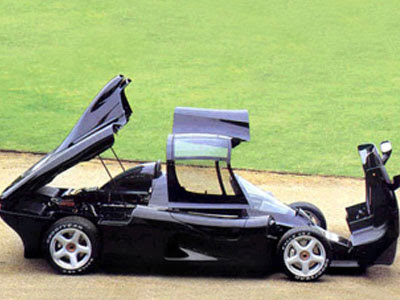
The new car featured an unusual and somewhat ugly design, features like the prominent front spoiler, tandem seating, cockpit shaped roof and protruding engine scoop stood out from other vehicles. Other features of the car which were rather extreme included the carbon fiber chassis and OX99 engine which were borrowed from the F1 car.
Budget disagreements meant the Yamaha OX99-11 project was taken from IAD and handed over to Ypsilon Technology, who were given 6 months to finish the project. A further blow to the project was came in the form of a financial crisis which hit Japan and it was decided that there wouldn't be enough buyers capable of handing over the vast sums of money needed to buy the car. In 1994 the Yamaha OX99-11 project was axed. By this point only 3 prototypes had been constructed.
The Yamaha OX99-11 was a supspercar designed by IAD, an English engineering consultancy, and Yamaha subsidiary Yilon Technology.
While the Yamaha OX99-11 was originally slated to appear in 1994, the roots of the OX99-11 project began in 1989 when Yamaha began competing in Formula One, later this spawned the desire to create a supercar based on Formula One technology.
Despite the fact the Formula One team was less than competitive, a new engine called the OX99 appeared in 1991, helping to give the new car a name.

Yamaha OX99-11 Supercar 3498 cc V12
The new car featured an unusual and somewhat ugly design, features like the prominent front spoiler, tandem seating, cockpit shaped roof and protruding engine scoop stood out from other vehicles. Other features of the car which were rather extreme included the carbon fiber chassis and OX99 engine which were borrowed from the F1 car.
Budget disagreements meant the Yamaha OX99-11 project was taken from IAD and handed over to Ypsilon Technology, who were given 6 months to finish the project. A further blow to the project was came in the form of a financial crisis which hit Japan and it was decided that there wouldn't be enough buyers capable of handing over the vast sums of money needed to buy the car. In 1994 the Yamaha OX99-11 project was axed. By this point only 3 prototypes had been constructed.
Yamaha OX99-11 Supercar 3498 cc V12
Yamaha OX99-11 Supercar 3498 cc V12
Yamaha initially approached a German company to come up with some designs for the supercar. However Yamaha dismissed the proposals as they were considered to similar to existing supercars. IAD were at this point hired to continue work on the project. In 1992 IAD came with an initial version of the OX99-11.
The Yamaha OX99-11 was a supspercar designed by IAD, an English engineering consultancy, and Yamaha subsidiary Yilon Technology.
While the Yamaha OX99-11 was originally slated to appear in 1994, the roots of the OX99-11 project began in 1989 when Yamaha began competing in Formula One, later this spawned the desire to create a supercar based on Formula One technology.
Despite the fact the Formula One team was less than competitive, a new engine called the OX99 appeared in 1991, helping to give the new car a name.
The new car featured an unusual and somewhat ugly design, features like the prominent front spoiler, tandem seating, cockpit shaped roof and protruding engine scoop stood out from other vehicles. Other features of the car which were rather extreme included the carbon fiber chassis and OX99 engine which were borrowed from the F1 car.
Budget disagreements meant the Yamaha OX99-11 project was taken from IAD and handed over to Ypsilon Technology, who were given 6 months to finish the project. A further blow to the project was came in the form of a financial crisis which hit Japan and it was decided that there wouldn't be enough buyers capable of handing over the vast sums of money needed to buy the car. In 1994 the Yamaha OX99-11 project was axed. By this point only 3 prototypes had been constructed.
The Yamaha OX99-11 was a supspercar designed by IAD, an English engineering consultancy, and Yamaha subsidiary Yilon Technology.
While the Yamaha OX99-11 was originally slated to appear in 1994, the roots of the OX99-11 project began in 1989 when Yamaha began competing in Formula One, later this spawned the desire to create a supercar based on Formula One technology.
Despite the fact the Formula One team was less than competitive, a new engine called the OX99 appeared in 1991, helping to give the new car a name.
Yamaha OX99-11 Supercar 3498 cc V12
The new car featured an unusual and somewhat ugly design, features like the prominent front spoiler, tandem seating, cockpit shaped roof and protruding engine scoop stood out from other vehicles. Other features of the car which were rather extreme included the carbon fiber chassis and OX99 engine which were borrowed from the F1 car.
Budget disagreements meant the Yamaha OX99-11 project was taken from IAD and handed over to Ypsilon Technology, who were given 6 months to finish the project. A further blow to the project was came in the form of a financial crisis which hit Japan and it was decided that there wouldn't be enough buyers capable of handing over the vast sums of money needed to buy the car. In 1994 the Yamaha OX99-11 project was axed. By this point only 3 prototypes had been constructed.
Cardi Curara Sports Car V12 engine

Cardi Curara Sports Car V12 engine
Cardi Curara is a convertible 2 seat sports car from Russia. Power for the Curara comes from a front mounted BMW V12 engine supplying power to the rear wheels.

Cardi Curara Sports Car V12 engine
The chisled styling of the Cardi Curara was highly advanced for its time. The front end is dominated by the large central air intake and slit like headlights on either side. Below are two prominent circular driving lights sculpted into the bodywork. At the rear, the spare wheel is sunk into the bootlid in a modern twist on the style often found on 1930's sports cars. The taillights are almost invisible, recessed into a single slit running the width of the vehicle.
Subscribe to:
Posts (Atom)


