


Thursday, 15 October 2009

Yamaha OX99-11 Supercar 3498 cc V12


Yamaha OX99-11 Supercar 3498 cc V12

Yamaha initially approached a German company to come up with some designs for the supercar. However Yamaha dismissed the proposals as they were considered to similar to existing supercars. IAD were at this point hired to continue work on the project. In 1992 IAD came with an initial version of the OX99-11.
The Yamaha OX99-11 was a supspercar designed by IAD, an English engineering consultancy, and Yamaha subsidiary Yilon Technology.
While the Yamaha OX99-11 was originally slated to appear in 1994, the roots of the OX99-11 project began in 1989 when Yamaha began competing in Formula One, later this spawned the desire to create a supercar based on Formula One technology.
Despite the fact the Formula One team was less than competitive, a new engine called the OX99 appeared in 1991, helping to give the new car a name.
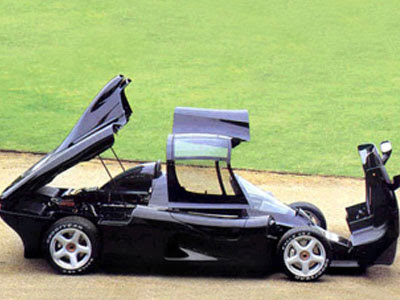
Yamaha OX99-11 Supercar 3498 cc V12

The new car featured an unusual and somewhat ugly design, features like the prominent front spoiler, tandem seating, cockpit shaped roof and protruding engine scoop stood out from other vehicles. Other features of the car which were rather extreme included the carbon fiber chassis and OX99 engine which were borrowed from the F1 car.
Budget disagreements meant the Yamaha OX99-11 project was taken from IAD and handed over to Ypsilon Technology, who were given 6 months to finish the project. A further blow to the project was came in the form of a financial crisis which hit Japan and it was decided that there wouldn't be enough buyers capable of handing over the vast sums of money needed to buy the car. In 1994 the Yamaha OX99-11 project was axed. By this point only 3 prototypes had been constructed.

Yamaha OX99-11 Supercar 3498 cc V12


Yamaha OX99-11 Supercar 3498 cc V12

Yamaha initially approached a German company to come up with some designs for the supercar. However Yamaha dismissed the proposals as they were considered to similar to existing supercars. IAD were at this point hired to continue work on the project. In 1992 IAD came with an initial version of the OX99-11.
The Yamaha OX99-11 was a supspercar designed by IAD, an English engineering consultancy, and Yamaha subsidiary Yilon Technology.
While the Yamaha OX99-11 was originally slated to appear in 1994, the roots of the OX99-11 project began in 1989 when Yamaha began competing in Formula One, later this spawned the desire to create a supercar based on Formula One technology.
Despite the fact the Formula One team was less than competitive, a new engine called the OX99 appeared in 1991, helping to give the new car a name.
Yamaha OX99-11 Supercar 3498 cc V12

The new car featured an unusual and somewhat ugly design, features like the prominent front spoiler, tandem seating, cockpit shaped roof and protruding engine scoop stood out from other vehicles. Other features of the car which were rather extreme included the carbon fiber chassis and OX99 engine which were borrowed from the F1 car.
Budget disagreements meant the Yamaha OX99-11 project was taken from IAD and handed over to Ypsilon Technology, who were given 6 months to finish the project. A further blow to the project was came in the form of a financial crisis which hit Japan and it was decided that there wouldn't be enough buyers capable of handing over the vast sums of money needed to buy the car. In 1994 the Yamaha OX99-11 project was axed. By this point only 3 prototypes had been constructed.

Cardi Curara Sports Car V12 engine


Cardi Curara Sports Car V12 engine

Cardi Curara is a convertible 2 seat sports car from Russia. Power for the Curara comes from a front mounted BMW V12 engine supplying power to the rear wheels.
Cardi Curara Sports Car V12 engine

The chisled styling of the Cardi Curara was highly advanced for its time. The front end is dominated by the large central air intake and slit like headlights on either side. Below are two prominent circular driving lights sculpted into the bodywork. At the rear, the spare wheel is sunk into the bootlid in a modern twist on the style often found on 1930's sports cars. The taillights are almost invisible, recessed into a single slit running the width of the vehicle.

Cardi Curara Sports Car V12 engine


Cardi Curara Sports Car V12 engine

Cardi Curara is a convertible 2 seat sports car from Russia. Power for the Curara comes from a front mounted BMW V12 engine supplying power to the rear wheels.
Cardi Curara Sports Car V12 engine

The chisled styling of the Cardi Curara was highly advanced for its time. The front end is dominated by the large central air intake and slit like headlights on either side. Below are two prominent circular driving lights sculpted into the bodywork. At the rear, the spare wheel is sunk into the bootlid in a modern twist on the style often found on 1930's sports cars. The taillights are almost invisible, recessed into a single slit running the width of the vehicle.

Chrysler Firepower V8 engine The extreme rear of the sport concept car

Chrysler Firepower V8 engine The extreme rear of the sport concept car

The Chrysler Firepower is an attractive and powerful concept, reaching 60 miles an hour in less than 4.5 seconds and continuing on to 175mph.
The Chrysler Firepower is based on a Dodge Viper chassis, and it's not impossible to see a resemblance. Muscular rear arches, wide low and flat bonnet and a cockpit pushed to the extreme rear of the car.
The rear view, especially the taillights and boot lid, have a distinct Aston Martin vibe. This similarity is not by accident, both cars are intended as luxury tourers designed to compete in the same market. Although the Firepower would probably be termed 'the poor mans Aston Martin.
Chrysler Firepower V8 interior

Chrysler Firepower V8 engine The extreme rear of the sport concept car

Chrysler Firepower V8 engine The extreme rear of the sport concept car

The Chrysler Firepower is an attractive and powerful concept, reaching 60 miles an hour in less than 4.5 seconds and continuing on to 175mph.
The Chrysler Firepower is based on a Dodge Viper chassis, and it's not impossible to see a resemblance. Muscular rear arches, wide low and flat bonnet and a cockpit pushed to the extreme rear of the car.
The rear view, especially the taillights and boot lid, have a distinct Aston Martin vibe. This similarity is not by accident, both cars are intended as luxury tourers designed to compete in the same market. Although the Firepower would probably be termed 'the poor mans Aston Martin.
Chrysler Firepower V8 interior

Wednesday, 14 October 2009

2009 LM5 McLaren Concept Car by Matt Williams


2009 LM5 McLaren Concept Car

The LM5 was designed as a vehicle which could rekindle the drama and sophistication of the legendary McLaren F1. And while McLaren have since revealed the MP4-12C supercar, it's not exactly in the same league as the technological tour-de-force which was the original F1.
The McLaren LM5 is a concept created by Matt Williams, a graduate of Coventry University's Transportation Design degree program. The LM5 was produced as his final year project.
The styling of the F1 was primarily dictated by function. However it also retained a unique sense of character and presence. Williams thought it would be interesting to develop the brand identity of McLaren - but more specifically the F1 model - and bring it into the 21st Century. And while the LM5 concept was designed to offer a similar personality and overall stance to the F1, it was also designed to utilize more extreme and race-influenced bodywork.
2009 LM5 McLaren Concept Car

The McLaren LM5 concept features the same three-seat layout with a central drivers seat as the old F1. All three sports seats have an extremely slim profile to reduce weight and free up interior space, and instead of conventional safety belts all the seats feature racing-style four-point harnesses. The multifunction steering wheel features a central display for the tachometer.
The proposed engine for the McLaren LM5 concept is a worked over 5.0 litre V10 sourced from BMW. Mounted midship in the carbon fibre pre-preg chassis this unit would make the LM5 a force to be reckoned with on both road and track.
While the LM5 is at the moment just one man's idea of what the F1's successor could look like, the design itself uses both past and present McLaren influences giving it a sense of realism. And It's important to remember that McLaren themselves have made it public knowledge that they're working on developing a successor to their most iconic car within the next couple of years.